
At Venice, a Documentary About Maine Made Me Homesick: Luke Lorentzen Finds a Different Kind of American Story
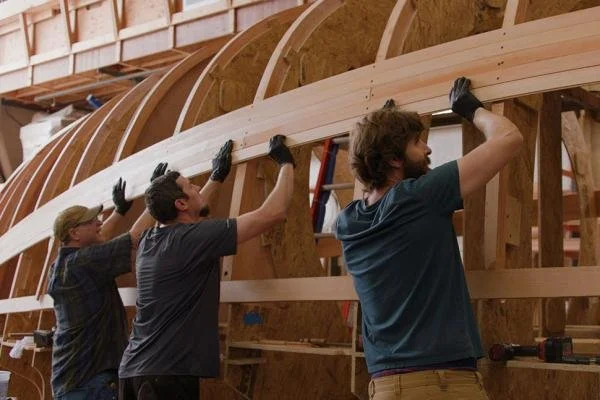
Luke Lorentzen’s Boatbuilders is a movie about the kind of work that takes a long time. Talking to Lorentzen afterward made me think about how much filmmaking does, too.
I didn't expect Boatbuilders to be the movie I remembered from Venice. This was my second film festival, and by the time I saw it, I had reached that point where everything starts to blend together. You watch one movie, walk into another theater, see a few minutes of something else because you have nowhere else to be, then spend the evening trying to remember which country the first one was from. Venice is full of movies that arrive with some kind of explanation attached to them. Big premieres. Directors you've heard of. Films people have been waiting months to see. Then there was this movie about a boatyard in Maine. Boatbuilders, directed by Luke Lorentzen, follows the workers at Brooklin Boat Yard as they spend roughly a year and a half building a 56-foot wooden sailboat. Lorentzen filmed there for around 16 months, following the project through four seasons. He lived nearby, including for a period in a small apartment above the garage of one of the boatyard employees. That's basically the movie . And I don't mean that as a criticism. The film is interested in the boat, obviously, but it is more interested in the people making it and the strange amount of time required to do something properly. You watch workers measure and cut wood and sand things down and start over. There are conversations at work and moments away from it. The boat slowly becomes recognizable.
I grew up in Hull, Massachusetts, a small town south of Boston. So I had an immediate advantage with this movie that I probably shouldn't pretend was universal. I know the type of place Lorentzen is filming. I know the people who have spent their entire lives around boats. I know what it sounds like when somebody talks about a boat as though they're talking about a member of the family. At one point a guy wearing a Patriots hat appears on screen, smoking a cigarette. I remember thinking, Oh, I know this exact guy. That feeling kept happening. The boatyard felt familiar in a way I wasn't expecting to feel in Venice. The movie made me think about home without ever having to tell me that it was supposed to. That is probably why I responded to Boatbuilders differently than I might have if I had watched it somewhere else. Lorentzen isn't trying to turn these people into symbols. He doesn't seem particularly interested in explaining what their work means for the future of America or the death of craftsmanship or whatever larger idea a documentary like this could easily be pushed toward. He watches people work. There is something nice about being allowed to watch somebody who knows what they're doing.
The film has a calmness to it, but I don't think calm is quite the same thing as slow. Lorentzen is constantly looking. A person drilling into ice. Workers sorting through a lobster catch. A lawnmower moving through a field. The seasons changing around the boatyard. A lot of these shots don't advance the construction of the boat in any obvious way, but they tell you what it feels like to be there in the moment. The official description of the film calls it a meditation on sustained attention. That phrase could sound pretty precious if the movie itself weren't so grounded. The point isn't that everyone needs to move to Maine and learn how to build a boat or anything like that (at least to me) It's that there are still places where the quality of your work depends on being willing to spend time with it. I didn't know how much of that was intentional until I talked to Luke.
Lorentzen grew up spending summers in Maine, and after finishing his previous film, A Still Small Voice, he wanted to make something that felt different. A Still Small Voice follows a hospital chaplain during a year-long residency at Mount Sinai, and the experience was emotionally difficult for him. After that, he wanted to make something that would let him fall back in love with the process of shooting. He started looking for something playful, something he could spend a long time with. He ended up at Brooklin Boat Yard. That decision makes more sense when you look at the rest of his work. Lorentzen's films tend to put him very close to people whose jobs are difficult to explain from the outside. Midnight Family, his 2019 documentary, follows a family running a private ambulance service in Mexico City. He spent three years with the family and eventually filmed around 80 nights inside their ambulance. A Still Small Voice took him into the world of hospital chaplaincy. He has also worked as a cinematographer and director on Last Chance U. Those subjects couldn't be much more different from a Maine boatyard, but the filmmaking instinct is similar. He wants to get close enough to a world that it stops feeling like a subject and starts feeling like a place where people actually live.
With Boatbuilders, he also wanted the experience of making the movie to feel different. He told me that after the intensity of A Still Small Voice, he wanted to spend time somewhere that made him feel good. Maine was already part of his life. His father is a sailor. He knew the area. The boatyard was familiar to his family. So instead of arriving with a fully formed documentary premise, he went there and started figuring it out. That is one of the things I find interesting about the movie. It doesn't feel like Lorentzen arrived knowing exactly what Boatbuilders needed to be. He had to wait for it. That sounds romantic until you remember what waiting actually means when you're making a documentary. It means spending a day at a boatyard and not knowing whether anything worth filming is going to happen, filming something because you think it might matter and finding out later that it doesn't. It means coming back tomorrow.
Luke has written about this pretty openly. Looking back on his work, he describes filmmaking as learning to trust the day-to-day process, what he calls "clock in and clock out." He doesn't mean that the work is mechanical. Quite the opposite. His point is that he has become more comfortable with not knowing exactly where a project is going. That idea came up when we talked. I asked him how he knows when he's actually getting somewhere with a film. Because I think that's one of the hardest parts of making anything. There is a period where you have an idea, and everything feels exciting. Then you actually start working on it. Eventually you're sitting with hours of footage or pages of writing or whatever the thing is, and you start wondering whether you ever had a good idea in the first place. Luke didn't make that uncertainty sound like something he had solved. He seemed more comfortable with it. He talked about the amount of time he is willing to give a project as one of the biggest things he can control. If he keeps showing up, keeps paying attention and keeps giving himself enough time to notice things, there is a better chance that something will emerge. You can see that philosophy in Boatbuilders. The film doesn't need a dramatic event every ten minutes because Lorentzen has given himself enough material to find the small moments that hold your attention. That is harder than it sounds.
The movie looks simple ans It wasn't made simply. Most of it was shot by Lorentzen himself. He was the cinematographer and editor as well as the director. The Venice program credits him for cinematography, editing and sound, alongside his producing partner Kellen Quinn. And there is a funny connection between that and the people he's filming. The boatbuilders have spent years learning how to notice things that someone else might miss. Lorentzen has done the same thing with a camera. He told me that one of the things he liked about being at the boatyard was rediscovering the feeling he had when he was younger and making little films. Stanford's profile of him describes Boatbuilders as a project that taught him to "play, look, and explore" again, the way he did when he was 12. That came up in our conversation in a way that felt much less polished than it does written down.
We started talking about the movie. Then we started talking about making movies. I'm 24. I'm trying to make films myself, and there is a particular kind of anxiety that comes with being that age and trying to figure out whether you're actually building a career or just talking about building one. You see other people moving ahead. Somebody gets a movie into a festival. Somebody gets a manager. Somebody sells something. Somebody you went to school with is suddenly directing something you saw advertised on Instagram. It can make you feel like there is a schedule you're supposed to be keeping up with. I asked Luke about that because, from the outside, his career can look like a pretty clean progression. He graduated from Stanford in 2015. Midnight Family premiered at Sundance in 2019, won the festival's U.S. Documentary Special Jury Award for Cinematography and was later shortlisted for an Oscar. A Still Small Voice premiered at Sundance in 2023 and won him the U.S. Documentary Directing Award. Now Boatbuilders has premiered in Venice. But that isn't what it felt like talking to him. He talked about his earlier projects as experiments and not knowing what would happen next. We talked about still having to figure out how to make the work he wants to make sustainable. That was more interesting to me than hearing about the awards.
Because if you're young and trying to make films, the awards aren't really the useful part. By the time you're looking at somebody's Sundance award or Venice premiere, the important decisions have already happened. The person made the thing before anyone knew whether it was going to work. Luke told me that when he was around my age, he went to Mexico City and started making a film. He didn't have the career that exists now. He didn't know where that project would lead. He went anyway. That film became Midnight Family. There is obviously a lot more to the story than that. He had collaborators. He found producers. He spent years working on it. It took a huge amount of time and effort. But there is still something useful about the fact that the beginning was basically a young filmmaker going somewhere because he wanted to make a movie. I asked him what he would do if he were in my position again. He said he would do everything he could to make a movie. I've thought about that answer more than I expected to. Not because it's profound. It really isn't. That's probably why I remember it.
There are so many ways to spend time around filmmaking without actually making anything. You can go to festivals. You can meet people. You can read interviews with directors. You can convince yourself that you're preparing for the movie you're going to make when you finally have the money or the equipment or the right idea. At some point, you have to find out what happens when you actually make the thing. I think that's also what I liked about Boatbuilders. The movie never needed the boat to become a metaphor for my life. It didn't need to tell me that slow craftsmanship is the answer to modern society or that Maine has somehow preserved a purer way of living. Those ideas are there if you want them, but the movie is better when it stays with the people. A man works on a boat. He goes home. The weather changes. He comes back. The boat gets a little closer to being finished.
After spending 16 months there, Lorentzen eventually had a film. After spending years working on his own career, he ended up in Venice showing it to an audience that had flown across the world to watch movies. And then I happened to run into him in an airport. That part still makes me laugh. I went to Venice expecting to watch a lot of movies and probably forget most of them. Instead, I ended up sitting in a theater watching a film that reminded me of where I grew up, then meeting the filmmaker a few days later and talking to him about why he made it. The movie made me think about home. The conversation made me think about work. And, maybe most usefully, it made me think about how little any of us actually know when we start making something.
What I took from talking to Luke was that filmmaking is mostly about learning how to work through uncertainty. You can spend weeks wondering whether a scene is actually working, or whether the idea you had in your head is anywhere close to what you're seeing in front of you. A lot of filmmaking happens in that gap. You shoot, you go home, you look at the footage, and you start to understand what you were really trying to capture. Then you do it again the next day. The more you work, the better you become at recognizing those moments when something is actually there.
That's what I started to appreciate about Boatbuilders after talking to him. The film feels effortless because so much thought went into making it feel that way. Knowing when to stay with a shot, when a conversation has enough life in it to keep watching, when a seemingly insignificant moment belongs in the film, those are decisions you only get better at by making films. You don't need to have all of that figured out before you begin. Luke clearly didn't. His career seems to have been built through the process of making one project, learning from it, and carrying that experience into the next. For me, that's the encouraging part. You can learn the craft by doing the work. You can make something before you're completely sure you're ready. And if you keep making things, you eventually start to see what you're capable of.
FOR MORE INFO ON BOATBUILDERS PLEASE VISIT THE FILMS WEBSITE
https://boatbuildersfilm.com/