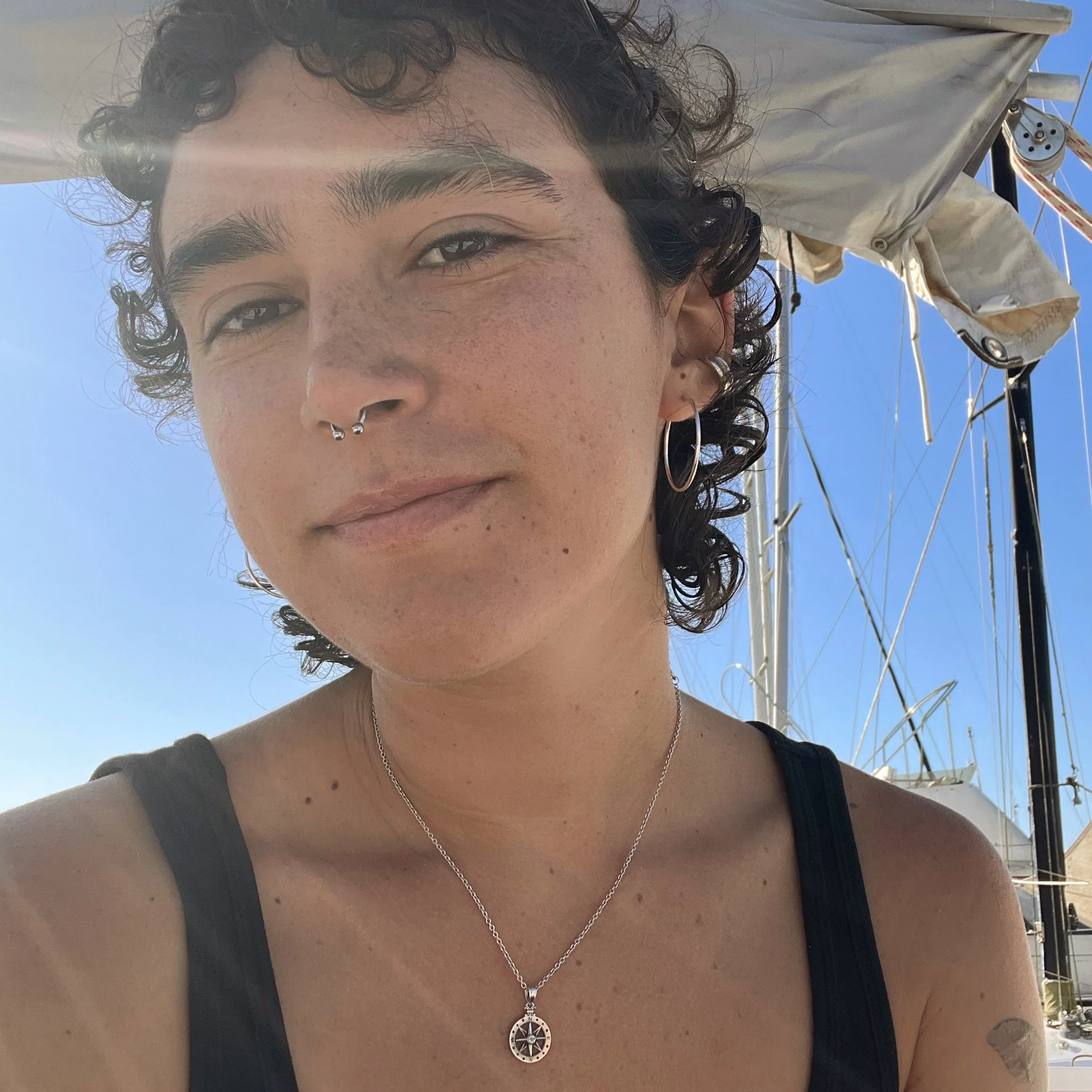
Moving Aboard a Wooden Catamaran
“Are we crazy?” This is what I asked my partner, Ethan, while we were on anchor, finally sitting down after being towed away from the yacht we had nearly crashed into the day before. My whole vision and confidence collapsed from the stress of attempting to captain a 50ft wooden catamaran and I cried a lot that week. This was Christmas week 2025.
Me and Ethan had crossed paths at the beginning of that year, both back in our home town, St. Augustine, Florida. As kids, the same amazing sailor had taught us how to sail. That got us hooked, leading Ethan to crew on larger sailing vessels and eventually doing a Pacific and Atlantic crossing, and me to the world of high performance single design dinghy racing and coaching. Same pastime, but wildly different facets. We both had found ourselves set into a routine of working 9-5s in town, Ethan as a marine electrician and me as software engineer. We quickly became friends and there was a shared feeling of wanting to move and do something new.
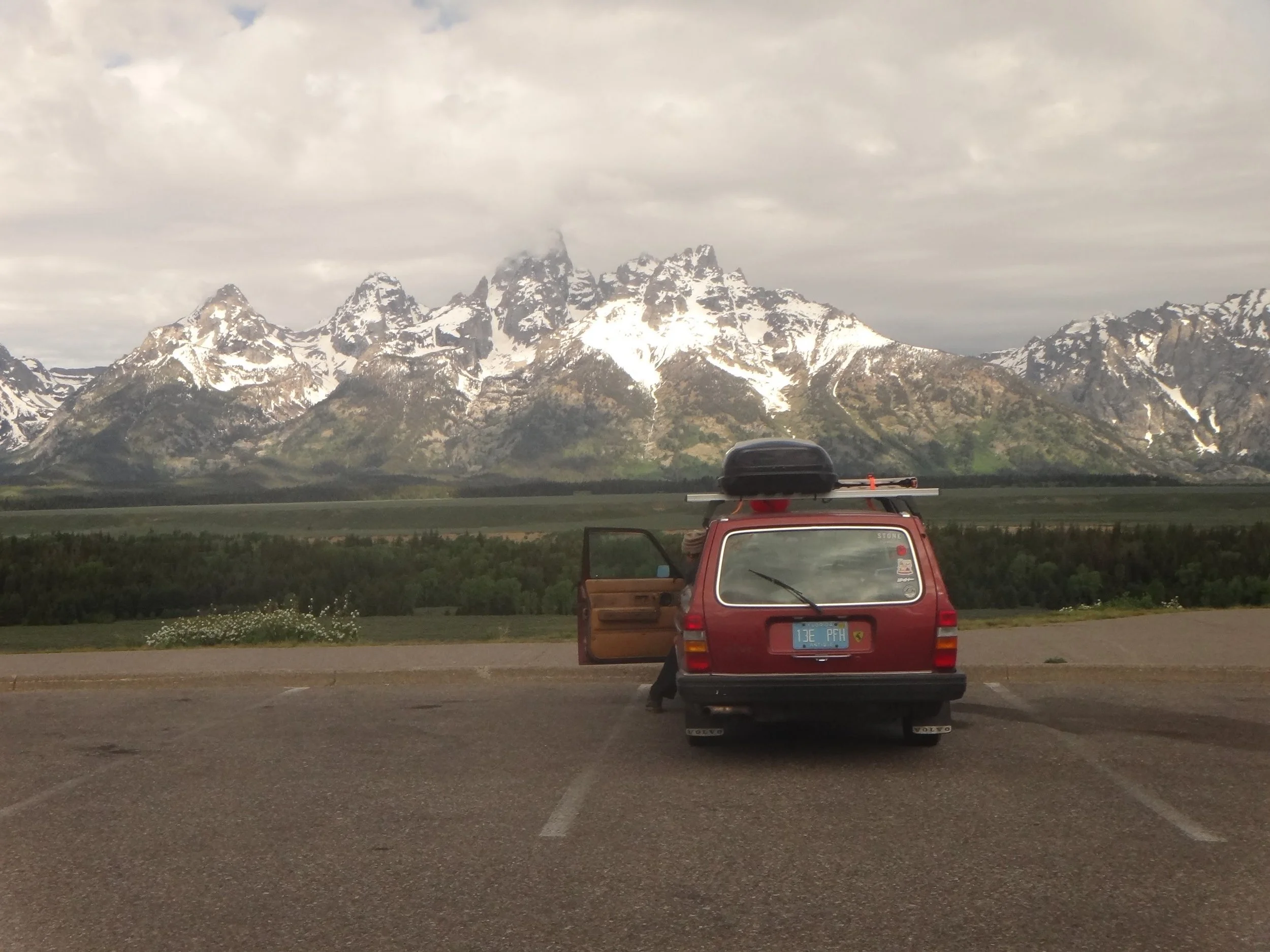
In the spring, Ethan invited me to drive to Washington state and back to attend a cousin’s wedding. I had lived in Washington the year before so it sounded like a fun way to reconnect with that side of the country and disappear from the work routine for a couple weeks. The hours of riding along slowly on back roads in Ethan’s ‘85 Volvo 240 Wagon gave us plenty of time to toss around ideas for future quests. One idea that naturally came up was a sailing trip. We both had plenty of old sailing dinghies at home that could be used for a weekend camping trip on a spoil island. But, we were thinking bigger! What about a large sail boat we could live on and sail across oceans?
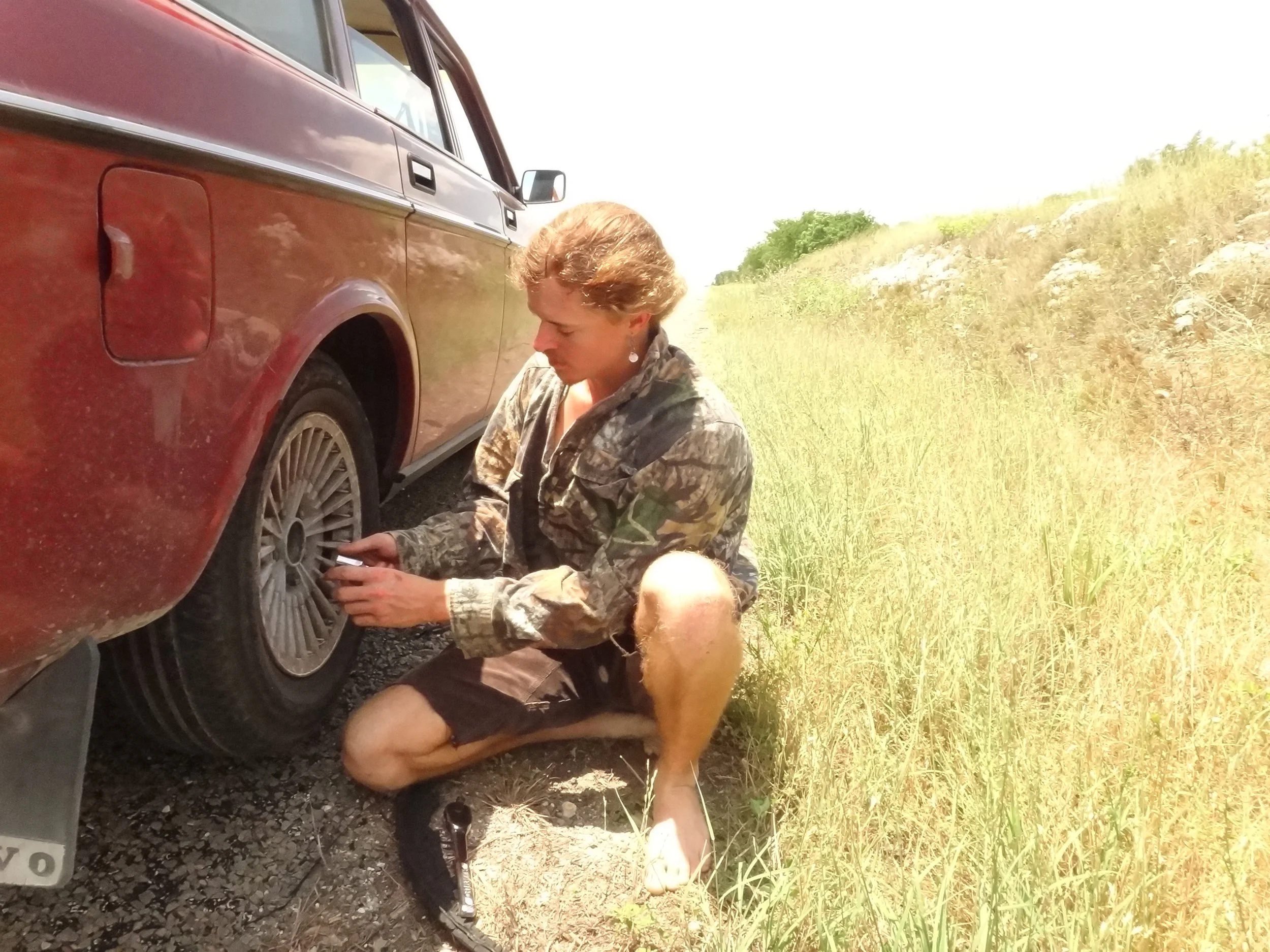
During this road trip in a 40 year old car we naturally ran into some issues. Namely a blown tire in North Texas in 40C heat, an alternator failure on the side of Mount Hood outside of Portland and a full brake bleeding operation in a mall parking lot in East Washington in the middle of the night. I was continuously impressed with Ethan’s mechanical and electrical knowledge and how calm and practical he stayed when things went wrong. We worked together to keep driving long distances to stay on our timeline while still having fun. By the end of the trip we were convinced we would be good boat owning partners (and not long after that, romantic partners too).
We decided a classic 35ft bluewater keelboat would be a good balance of our skills and our budget. At first, this seemed like one of those things you may just dream about and talk about for a long time but as soon as we returned to Florida we started looking for a boat. Even if we were not able to sail right away with our jobs in Florida, a boat also seemed like a practical home with the ever increasing cost of living in the area. The search was fun: scrolling Facebook market place, messaging strange Cragslist listings, and wandering around boatyards near home. The more boats we looked at, the better grasp I got on what makes a boat good for “living-aboard”.
One day during my lunch break I came across a particularly interesting listing: a Wharram Tiki 46 Catamaran named Follower. The only thing I knew about Wharrams was from the movie Women and the Wind*, which I had watched earlier in the year. This film was a big factor in me having a sudden desire to sail a larger boat. The listing was very intriguing and different from any boat I’d seen before. I sent the listing to Ethan and he was surprised I was interested in something so large and untraditional. She was in a boatyard only a couple hours away so we decided to go meet the owner for a tour that weekend, just for fun. At this point, Follower seemed wildly out of our size criteria and budget.
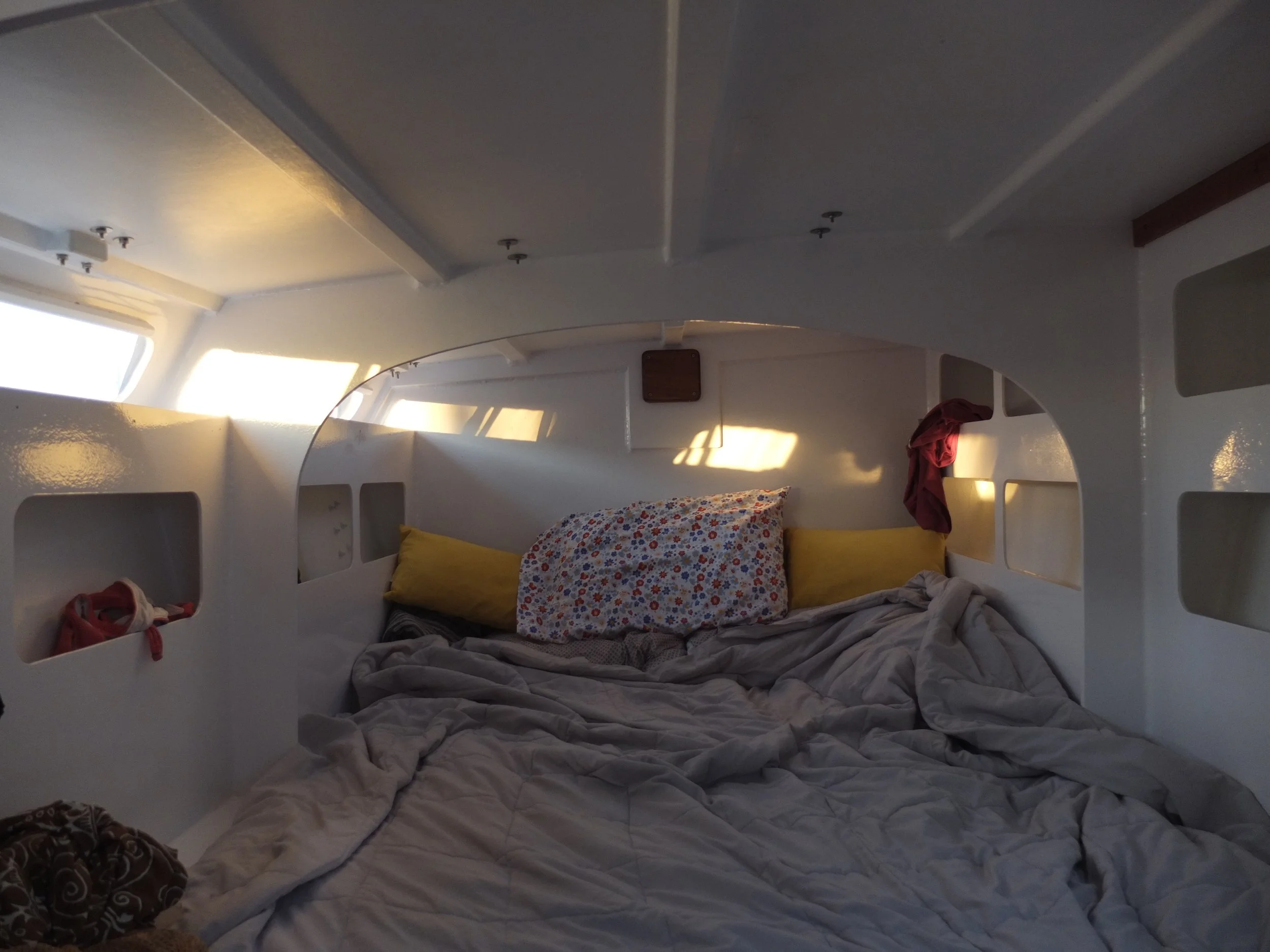
Meeting with the owners of Follower we learned she was home-built in Namibia Africa in 2006 by a German family. Follower was then sailed to South America and up to Florida where she was purchased by a family in Florida in 2014. This is Tom and Naomi, who lived in Cape Canaveral Florida. They were very thoughtful boat owners and took many hours showing us Follower. The first time I saw Follower in person I was in awe. I had never seen any boat like her. She was out of the water in Westland Boatyard up on blocks so you could see every curve of the deep V shaped hulls. She has a flat deck that makes her kind of look like a giant Hobie Cat. And most interesting of all she has equally sized two masts (a schooner rig). Also her two hulls are structurally attached by five huge wooden beams, lashed down to cradles on each hull. Moving around her deck felt like a playground, with beautiful wooden platforms between the hulls and beams (bridge deck) and hatches on the top of each hull leading down into different living spaces. The galley and saloon in the starboard hull and the berths and head in the port hull, all painted white with wood trim. The cockpit is located on the aft part on the bridge deck, with a hard top cover and small deck pod for taking cover during stormy sails.
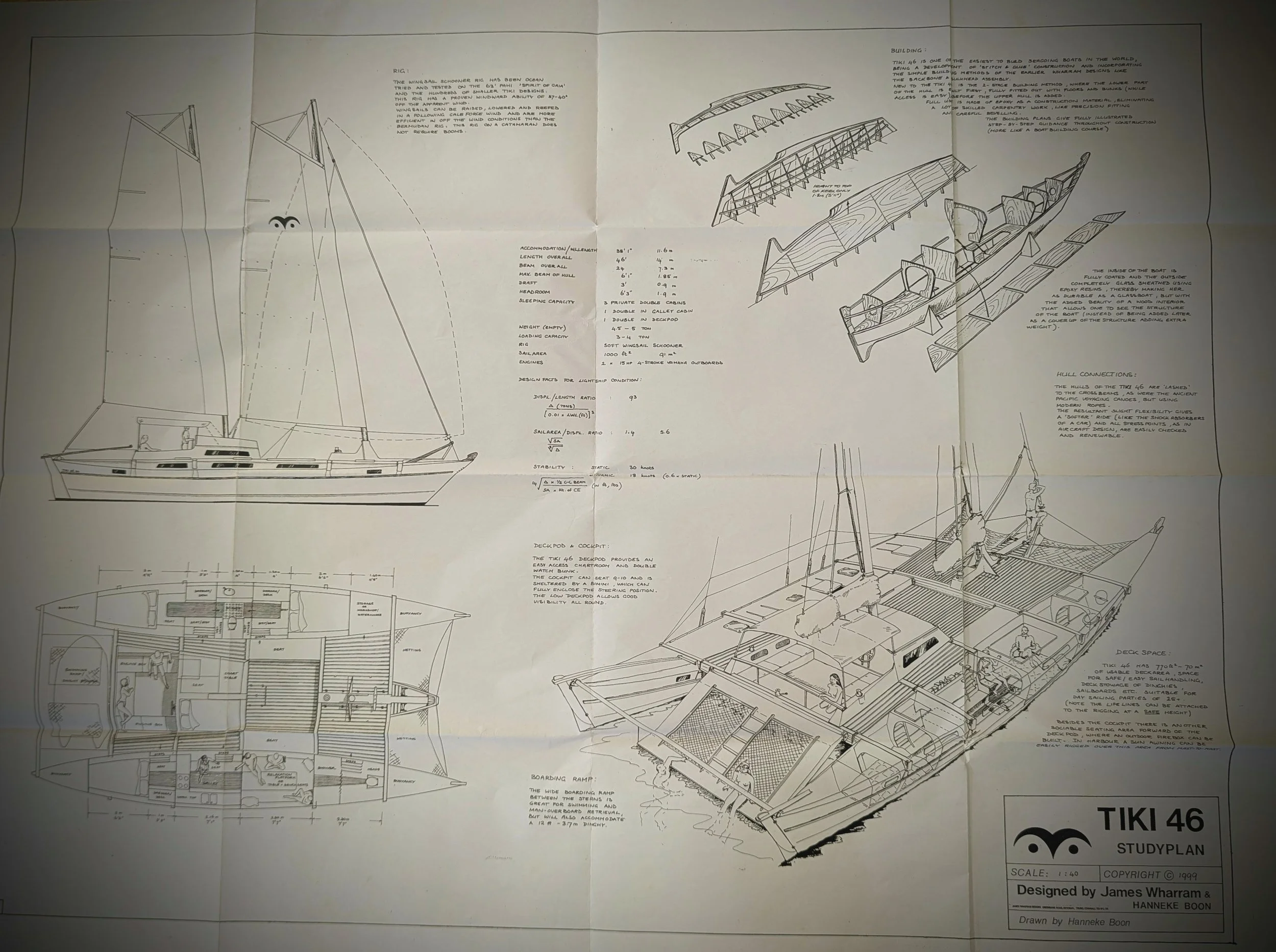
We quickly started learning about Follower’s Tiki 46 design and how her untraditional build has a deep history. James Wharram in the mid 50's, based on his designs on ancient Polynesian boats and built the first off-shore Catamaran in the Western world. At this time, multi-hull boats were thought to be unseaworthy. Wharram understood that the Polynesian had been crossing oceans in “double canoe” sailboats for many generations and he wanted to prove multi-hull sailboats were just as seaworthy as traditional European deep keeled monohulls. After many epic voyages across the Atlantic in his first homebuilt wooden Polynesian style double canoes, he started a business designing wooden sailing vessels; anywhere from 10 foot day sailors to 65 foot expedition boats. The idea is that the average person could buy Wharram design plans and materials, then be able to build their own boat. Wharram passed away in 2021, leaving a legacy in the sailing community and a wonderful Wharram business that still sells designs. One of his life and design partners, Hanneke Boon, still provides technical guidance to anyone who is building or owns a Wharram boat. I would highly recommend their book, “People of the Sea”, that tells the story of Wharram. The Tiki 46 is one of Wharram’s later designs that culminates many of the features that he and his crew found useful in their decades of sailing.
After visiting Follower for the first time, I could not stop thinking about her. Every time I closed my eyes, I just saw her sailing on the open ocean. Owning and living aboard her sounded unrealistic though. Me and Ethan spent two months talking about actual time and money logistics and touring with Follower many more times. Finally, we decided that this was a calling; it felt like a once in a lifetime opportunity that neither of us wanted to turn away. Follower was not just a boat, but also a home, a project, and a life on the water. We still joke that we had no clue what we were getting ourselves into.
I think in most life stories, the financial side is often left out. I guess due to it being considered boring or too personal. Finances were a pretty large factor in our decision to purchase Follower as our full time home so it is an important part of the story. The story most American generations have been told is, after you get a “real job”, to save up and make a down payment on a home. (By “real-job” I just mean something you get consistently paid to do.) For many generations, this has generally been a good way to set yourself up for housing security for the rest of your life. Now I’m not an economist or cultural expert but if you’re in your twenties right now you might be like I was questioning what “security” even means. My “real job” as a software engineer I started after college is high paying enough to think about saving up for down payment, which is not even an option for many. So with this as an option, many people in my life encouraged me to start looking for a house or building a house. It seemed like the right thing to do; however, deep down the thought of signing a mortgage that tied me to maintaining a high income for the next maybe 20 years, made me feel heavy. It seemed like a trap to live a lifestyle that is rooted in old practices and in a world that is changing very quickly. The economic, political and environmental climates do not seem like something that will stay predictable in my lifetime so buying a large voyaging boat feels like it will give me flexibility to live a lifestyle I love, no matter what is going on in the world.
There are many obvious benefits to the flexibility of living on a boat you own: You pay no monthly housing, unless you want to live on a dock. You can technically move almost anywhere in the world and take your home with you. You can learn highly valuable skills such as: living off grid, weather prediction, carpentry, electrical, and navigation. All of this can be very rewarding but uncomfortable, compared to the traditional western style houses. However, with traditional housing comes the ease of disconnecting. After a year of living in an apartment in a big city, I learned that disconnecting from the rhythms of the ocean was detrimental to my health. There is something about stepping away from air conditioning and flushing toilets to a world of cooling down in the water and composting my own waste, that brings a baseline sense of peace in my body. Wharrams are, by design, “bare” sailing boats and do not have space engineered for holding tanks, central air, or cover on the decks. So this almost forces you to live in touch with the elements around you.
Our offer on Follower was accepted in early August and on August 15th (my birthday), me and Ethan handed over a check and received Follower’s title. Once her previous owners left, it was just me, Ethan and Follower sitting in the boat yard with a lot of work ahead of us. Follower, hadn't been in the water in over 2 years and we set a deadline to get her ready to float by December (the end of hurricane season). At this point, we were living in St. Augustine for work and Follower was in a boat yard a two hour drive south in Titusville.
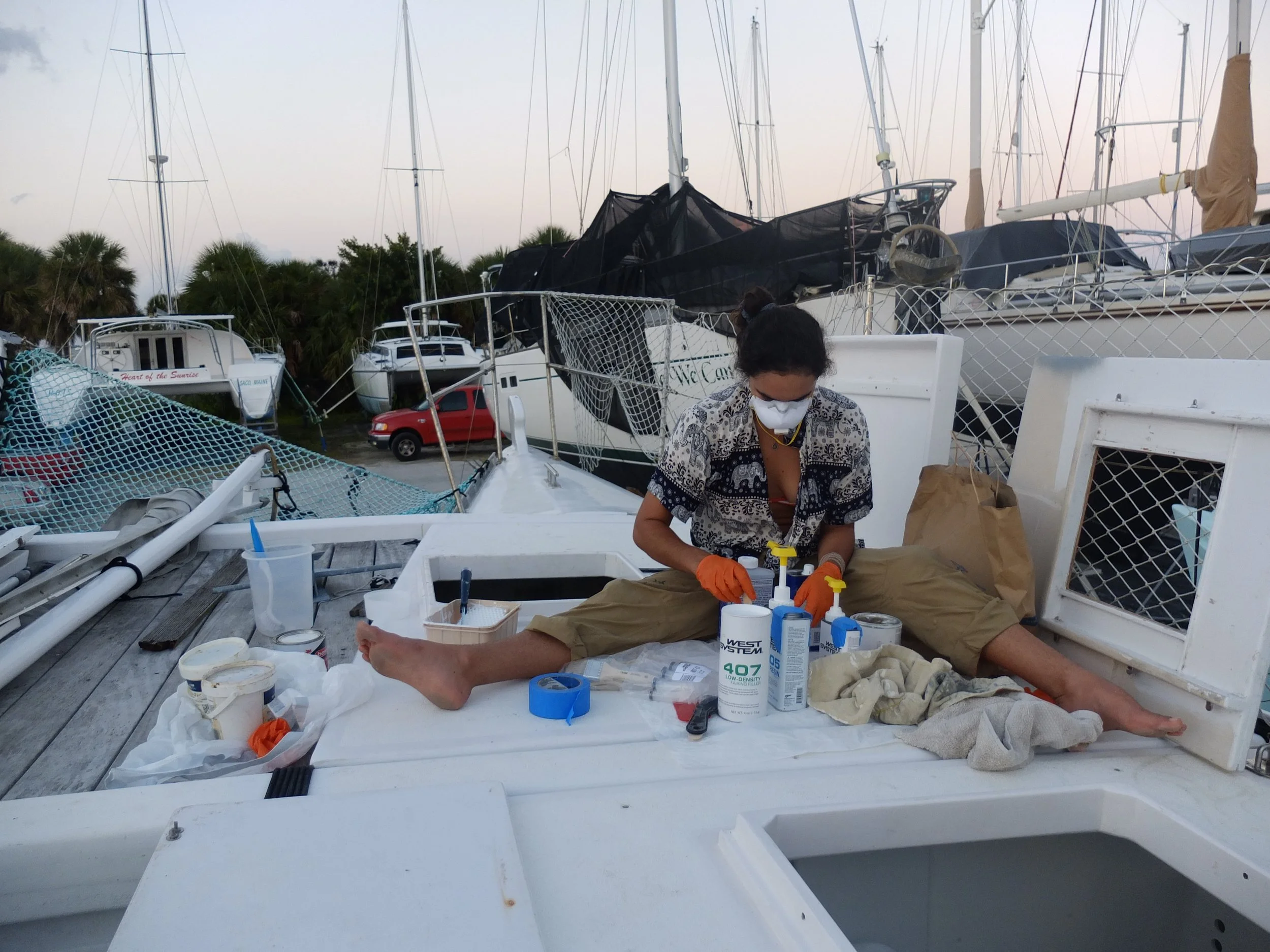
Me and Ethan underestimated how challenging it would be commuting and working on Follower every weekend. We quickly fell into the routine of packing up our car as we got out of work Friday evening, getting settled back onto Follower Friday night, working as much as we could in the boat yard, and then driving back to St. Augustine late Sunday with regular work starting Monday morning again. Another challenge became making sure we had the right tools and material for each weekend while staying on budget. We quickly learned to have a weekly Follower planning date, where we would list out all things we needed to buy and pack for the weekend. Many weeks this planning was harder than actually executing the work, which neither of us anticipated.
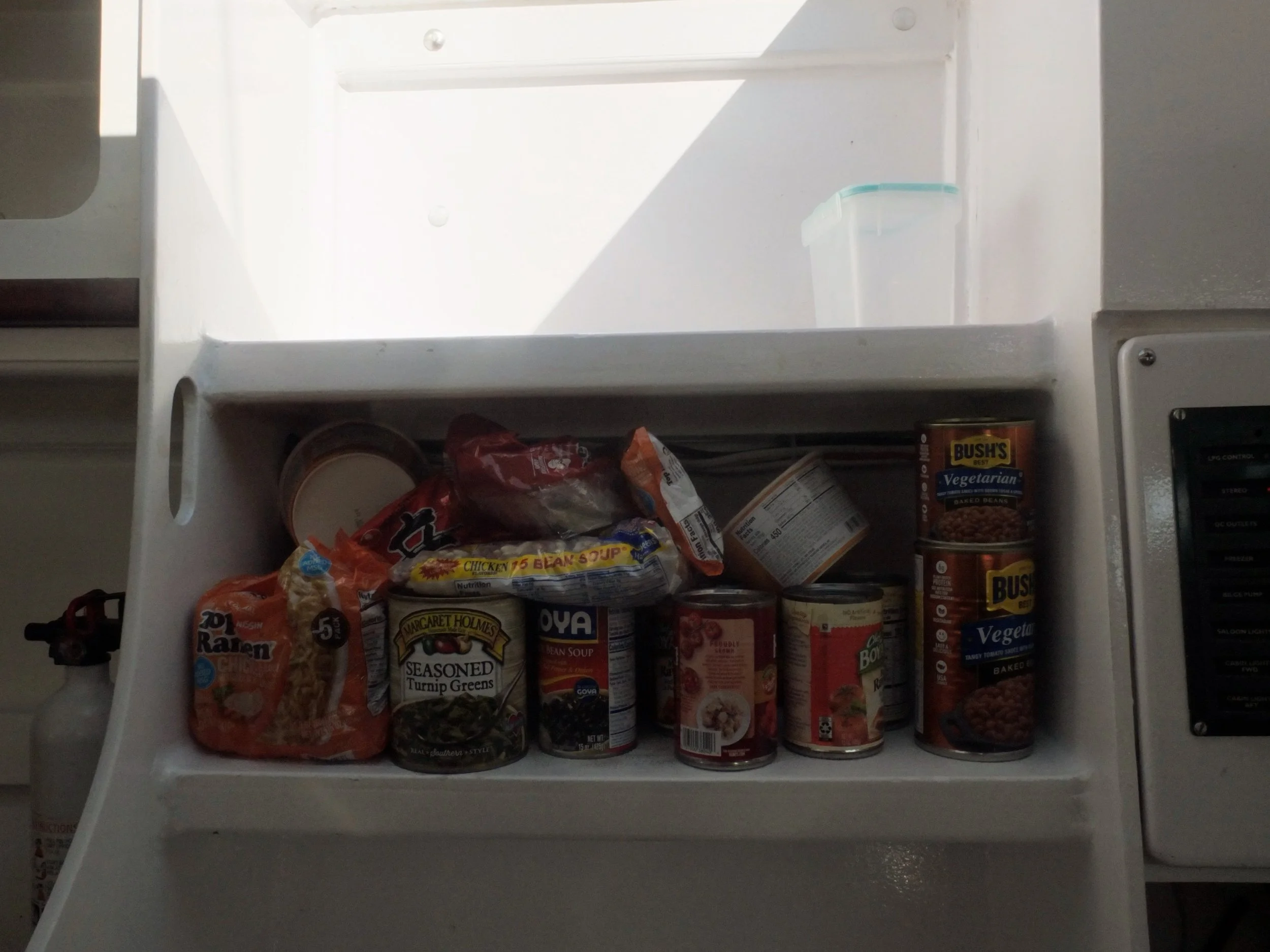
The first thing we did with Follower, was clean the inside of the hulls so we would be cozy living in her cabins on the weekends. Notability, we cleaned out lots and lots of cans and bags of beans that were stashed in every compartment from rations of previous owners. After a few weekends living aboard in the boat yard we started to fall into a rhythm. It was hot and some days it felt like we were moving too slow to make any progress. Luckily our neighbors in the boats around us were cheering us on. Most of them being at least 30 years older than us were just happy to see young people who are passionate about sailing. Also a midday walk to the local ice cream shop to cool down saved us from crashing midday.
Even though we had a marine survey done before buying Follower, we found many surprises, sometimes good, sometimes bad. There was a lot of helpful equipment and material buried (other than beans) in her inboard cubbies. We wanted to prioritize projects that are easier or necessary to do out of the water. The first one to tackle was an improved fresh water system. This water system overhaul would involve cutting holes in the hulls for new water lines, mounting new pumps and many unforeseen learning curves. However, a few weekends into this project, while I was carrying a water jug across the bridge decks one of the slates broke. My right leg fell through the deck and I caught myself on one of the beams. Ethan heard the wood break, and quickly came to help me back up. I was luckily totally unharmed, except for some adrenaline. There was about a 10 foot drop to the ground underneath Followers deck, which we used a ladder to climb. This accident was a wake up call that the bridge deck wood was in worse condition than we or the surveyor had thought.
Neither myself nor Ethan had much experience in carpentry work but owning a wooden boat was a sure way to force us to learn. We first needed to source marine grade wood to rebuild the bridge decks. You normally need to go to a special supplier to get marine hardwood which can be very expensive. After a bit of online searching we found a Facebook posting about a hobbyist carpenter who was selling some of his surplus. It seemed like it might be a scam but he ended up being a really cool guy who gave us a good deal and even delivered the wood for us. Part of why it was a good deal, was that the wood was unmilled. So now we had a bunch of approximately 10”X10” inch/10 foot long board of Sapele and Iroko (African hardwood) that needed to be milled down to thin slates for the decks. Using the old deck pieces we had unassembled as a reference, we started cutting them down at my brother-in-law's shop.
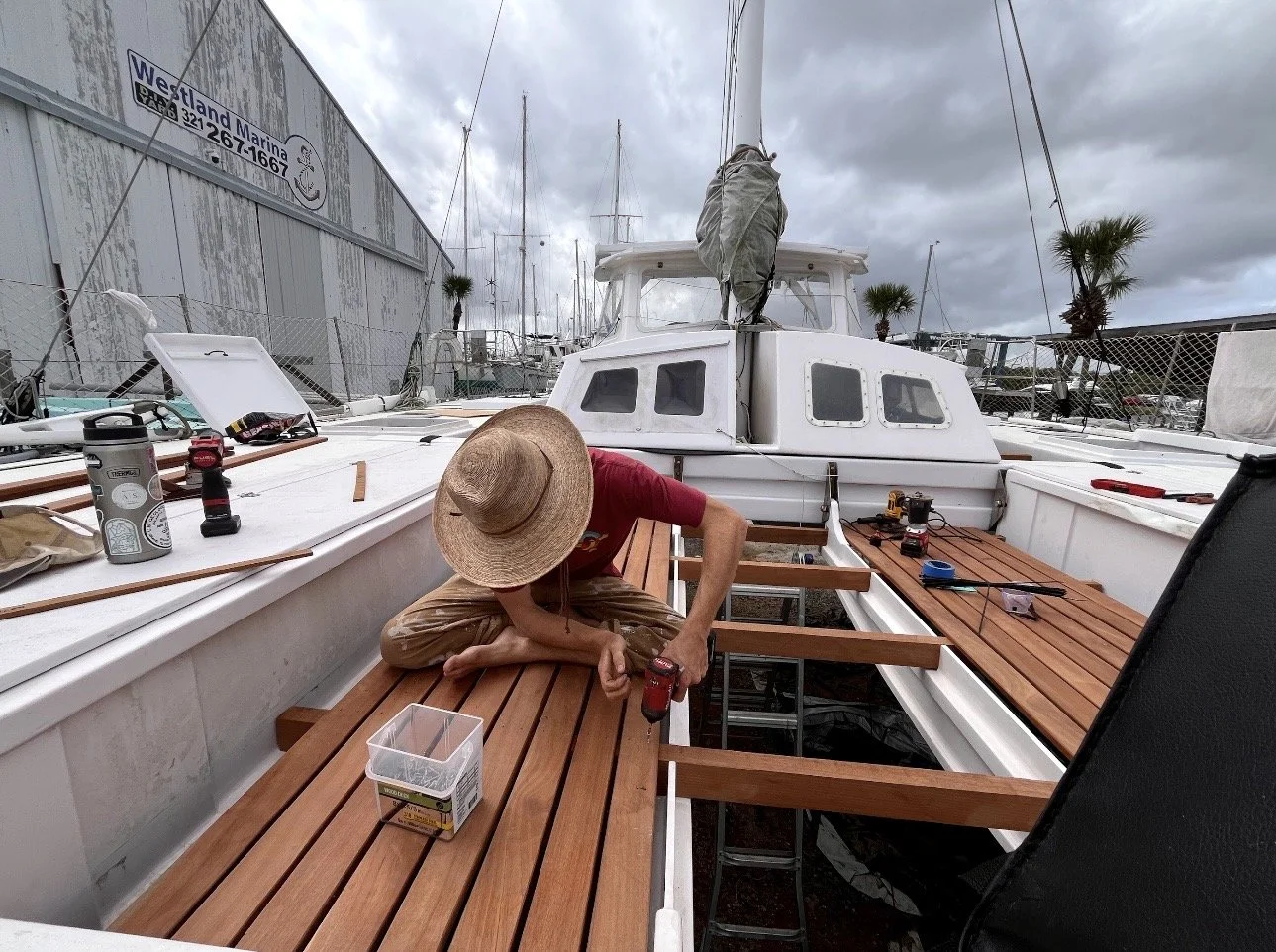
Milling, finishing and transporting the deck wood was time consuming but it was so rewarding to screw them down and finally walk across the hulls without just darting across the beams. At this point it was November and if we wanted to make the goal of being in the water by December, we needed to start preparing the bottom of Follower’s hulls. We needed to apply new bottom paint to the parts of the hull that sit underwater to prevent algae and barnacle growth. Epoxy would also need to be applied before the paint to touch up some areas of the hulls. Ideally we would sand out the old paint on the hulls, make sure it is dry, seal areas with epoxy if needed, sand again, prime, and then apply two coats of bottom paint. This whole process is very weather dependent too; so we were hoping for a dry, warm month.
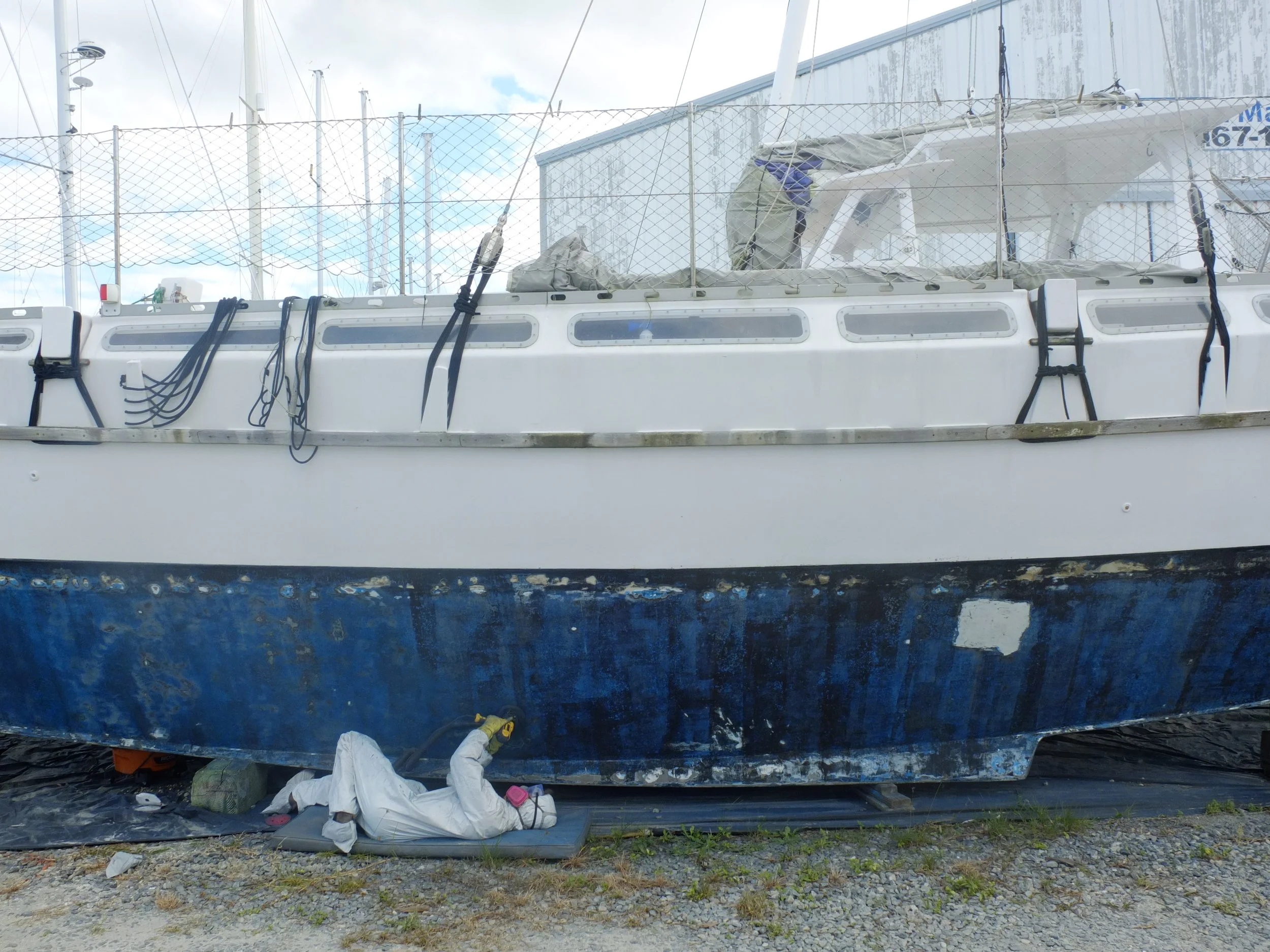
We got very lucky and the whole month ended up being perfect weather. Early December was a blur of strapping on Tevez suits, goggles, and respirators to sand and paint, all while making sure not to get this toxic dust inside the hulls where we were cooking and sleeping. Our friends, Caden and Nick, came down to help and I’m so thankful they were willing to do this kind of dirty work! This helped free up time for me to start packing up the house we were renting in St. Augustine. Ethan and I realized it was time to set a date to splash Follower. Follower is about 50 feet long and 25 feet wide on deck and therefore could not be put in the water with a normal “travel lift”. Instead we’d have to contract a crane company to come lift her. This whole project felt like it had become an operation and sometimes I forgot that it was me and Ethan running the whole thing.
The grand plan was to: move out of the rental house on the 17th, finish final prep and engine testing on the 18th-20th, take the 21st to rest, the crane would arrive the 22nd with a local rigger to help us get her in the water and rig her masts. Then we would start motoring up the river from Titusville to the dock we had rented in St. Augustine (hopefully to be back in time for Christmas with our families). Both myself and Ethan had captained many boats but nothing like Follower so we kept reassuring each other that everything would be ok.
On the 18th the two 25HP Yamaha outboard engines ran great hooked up to a hose in the boatyard. They were fairly new and we decided just to change the upper and lower unit oil and change the spark plugs. We also packed some extra parts in case we ran into any issues once we were in the water. On the 21st, Caden arrived and I was feeling ready to go. We had a crew, running engines, safe decks, solar power and plenty of water. While walking out of the boat yard to run some last minute errands, I saw another young couple in the boat yard! We were both shocked to see some sailors our own age. Teddy and Mazi had just hauled their boat out (Barbara-Ruth @washupssailing on Instagram) and were going to be there for a month. We had a pizza party on Follower that night to celebrate Follower’s last night in the yard and Barbara-Ruth’s first day.
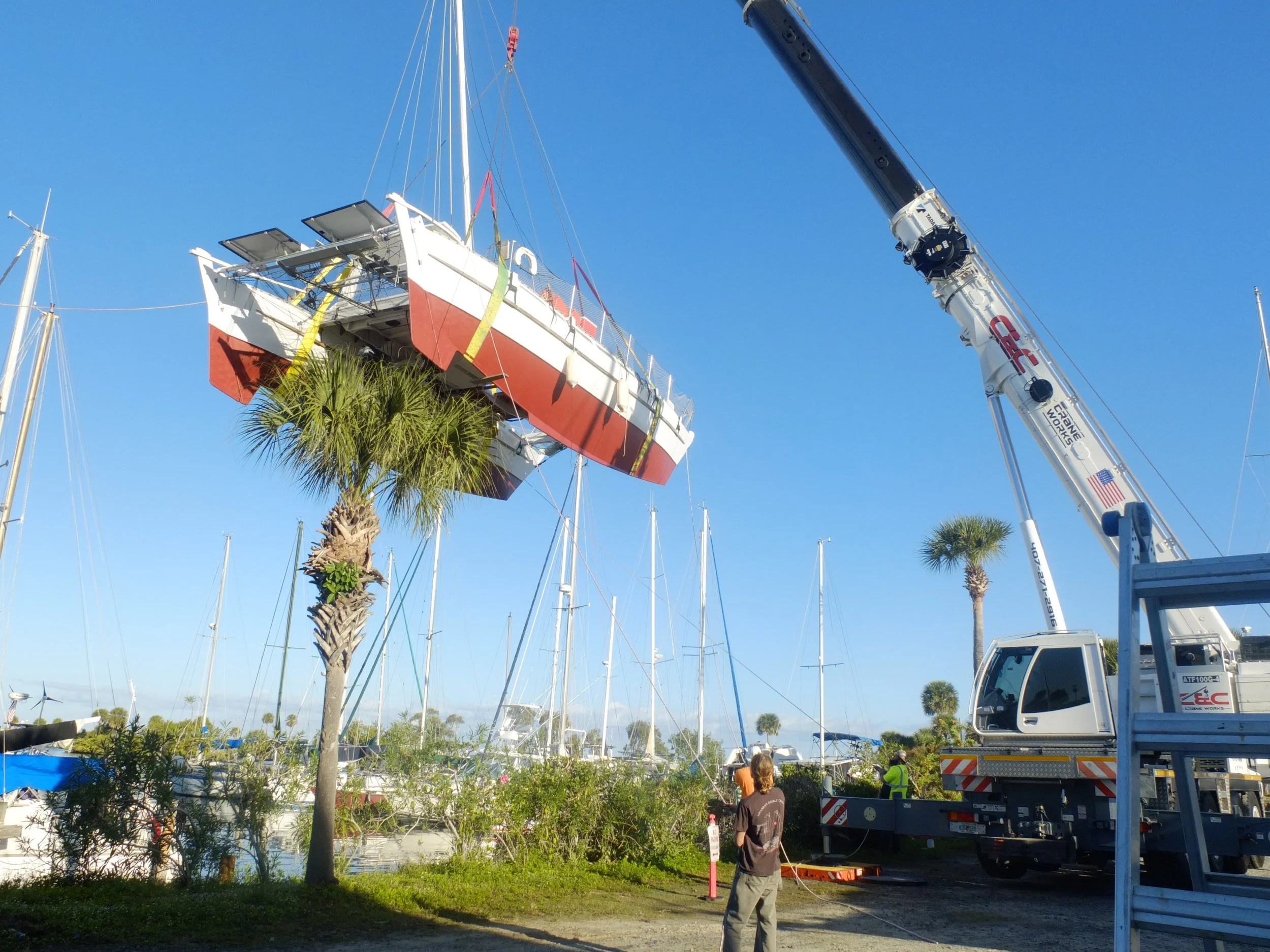
I didn’t sleep much that night and was wide awake at 05:00. At 07:00 on the 22nd the crane showed up at the boat yard. It was huge and accompanied with a parade of big trucks full of the counter weights. They quickly started setting the crane up next to Follower and the operators directed me, Ethan and Caden on how to help secure the straps around her hulls. Our families came to watch and brought us food but I was so nervous I could barely eat. To get here from dry dock to the water, she would have to be lifted over a palm tree, a pavilion, and other sailboats. Our boatyard neighbors to help hold lines to prevent Follower from swinging when the crane lifted her. The lift looked about as crazy as you would imagine. All eyes were on the Follower, 100 feet in the air. I think I was holding my breath. She was lowered slowly into the marina between a line of boat slips.
Follower was floating! Now we needed to quickly step the masts while the crane was there and drive out of the marina. To get out of the marina we would need to hand over hand pull her from the docks, being careful not to bump into any of the boats in the slips on either side. Then we would need to turn on the engines and back out slowly through the turning basin. There were at least 20 people including my parents, pushing Follower through the narrow space while Ethan used the rudders to steer and conduct the pullers. Me and Caden were in my trusty 10 foot dingy, Alice, under the bow of Follower making sure to fend off anything in between the docks. Alice is very old and was actually slowly sinking during all this, which added to the excitement.
Once Follower was in a wide enough spot to steer under engine power, me and Caden jumped aboard and hauled Alice up with us. It was time to drive away, There was a rush of excitement as we started backing out while everyone was yelling goodbye. Ethan was at the helm, we did a slow nice turn just as we had planned and started heading away. Suddenly, the engines started cutting out. My heart dropped and I immediately opened the engine compartments and started checking for obvious issues. At this moment a big gust of wind caught the side of the boat and we started drifting fast. We were heading right for a big yacht on the other side of the marina with no way to steer away. I tried to get the engines to run by manually pumping fuel bulb with my hand but they would still cut out. The only sure thing to do would be to drop the anchor and hope we didn’t drag or swing too far. I got on helm still trying to hand pump the fuel line while Ethan and Caden dropped the anchor. We were still drifting fast. The whole group of people on land watching us came running around the marina to try to catch us on the other side.
As we got a few feet away from the other boats and dock I saw a stranger jump from the dock into their inflatable dinghy and ram into the starboard side of Follower. This was Mathew and ended up being the best friend through this whole incident .His heroic act saved us from hitting the yacht. In the same moment the anchor finally took to the bottom and we stopped drifting backwards. But with the wind we started swinging sideways. Me and Caden went running to the port stern as we were about to hit a dock. Caden did a spiderman move, jumping from the stern to the dock and catching the stern before hitting the piling.
We were stopped and after a quick check to see if everyone was ok we looked to see if there was any damage. With part luck and part skill and help from everyone, Follower and the other boats were unharmed. I was shaking and wanted to just go down into my cabin and curl up in a ball in bed. I wasn’t sure how people were reacting. Does everyone just think we are some kids that don’t know what we are doing? Did I get myself in way over my head? It was quite the opposite. Even though our family, friends and neighbors were concerned, everyone was immediately asking how they could help. Some of the sailors in the marina reassured us that similar things had happened to them and a captain who had his boat next to us in the yard even apologized for telling us that the engines had sounded good while testing on land. There is really no good way to test an outboard engine under load other than just trying it. I don’t think I had realized how important reliable engines are for a large sailboat. While we can raise sails and sail across a large body of water, the engine must be used to maneuver around bridges and marinas in the intercoast waterways.
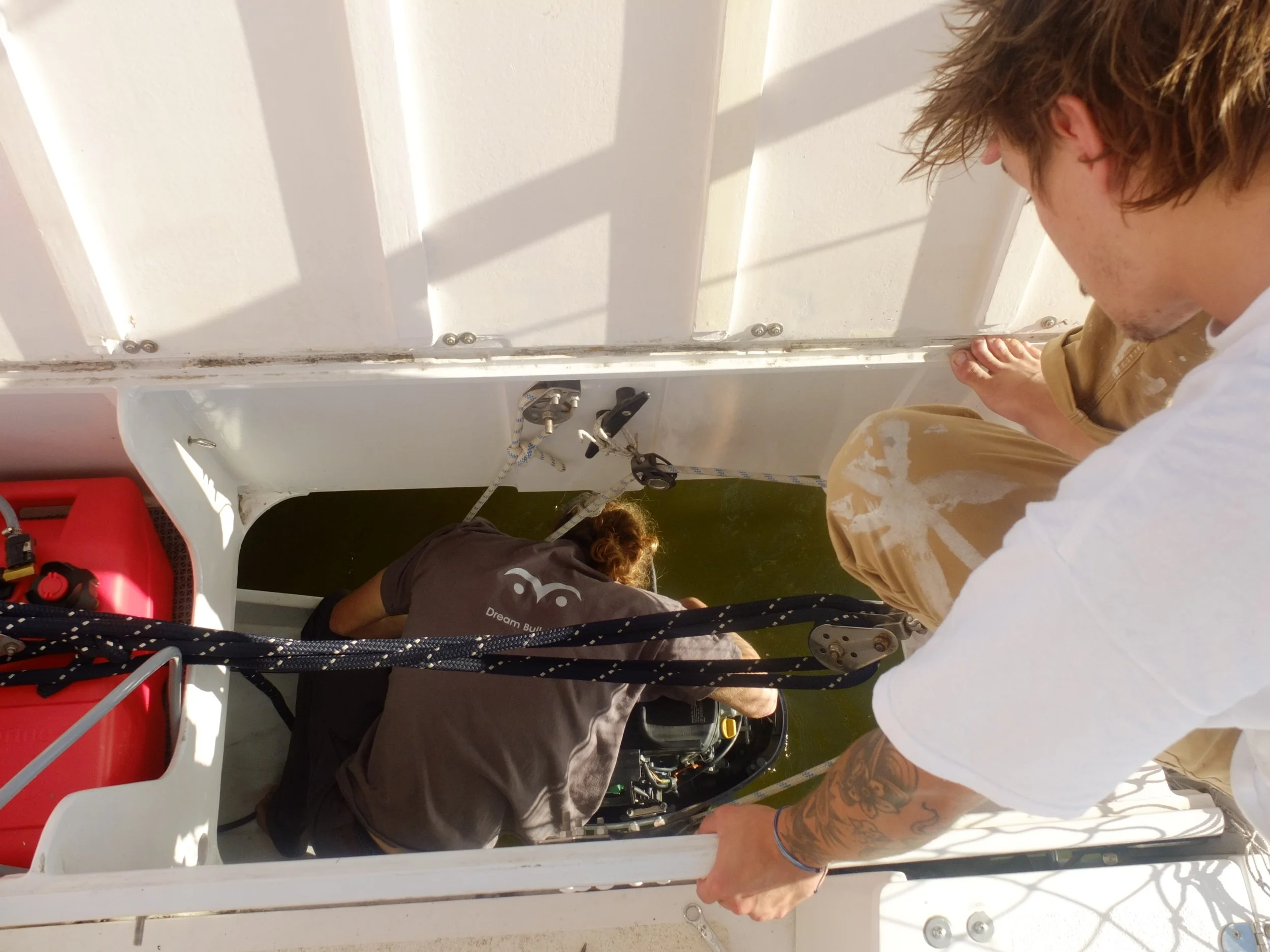
Now we were in a pickle. Follower was anchored in the middle of the marina, tied up to other boats, blocking in at least ten. We had to step onto Mathew’s boat to get on and off Follower. He quickly started listing off things that could be wrong with the engine and giving us encouragement while he smoked cigarettes on the dock. We decided that we were going to try to drop the lower units on both engines and replace the impellers, which thankfully was one the spare parts we had. This was not easy. We had to balance Alice in the water underneath the engines and perfectly line everything up as we took parts off so that nothing fell in the water. It was tedious work that went late into the night.
We slept for a couple hours that night and restarted the engines the next morning. They were still cutting out, less often than before but not reliable enough to try to move again. At this point we had to call a tow boat so we could get out of the marina. The tow boat operator was very friendly and got us out of the marina and into a nearby anchorage quickly. It felt relieving to be in the wide and peaceful river, away from other boats and people. I felt like I could finally take a deep breath for the first time in two days. Then the emotions from the past week came flooding out.
Doing something a bit different than the norm always puts you under more scrutiny and buying a large wooden boat brought forward some skeptics. I think this was the first time I really felt all my insecurities about the situation. It was Christmas and we were supposed to be celebrating in St. Augustine but I felt like I didn’t want to face telling this whole engine failure story yet. We spent Christmas anchored in the river. It was warm and calm and in the afternoon we took Alice over to a small spoil island where there were hundreds of little brown anole lizards.
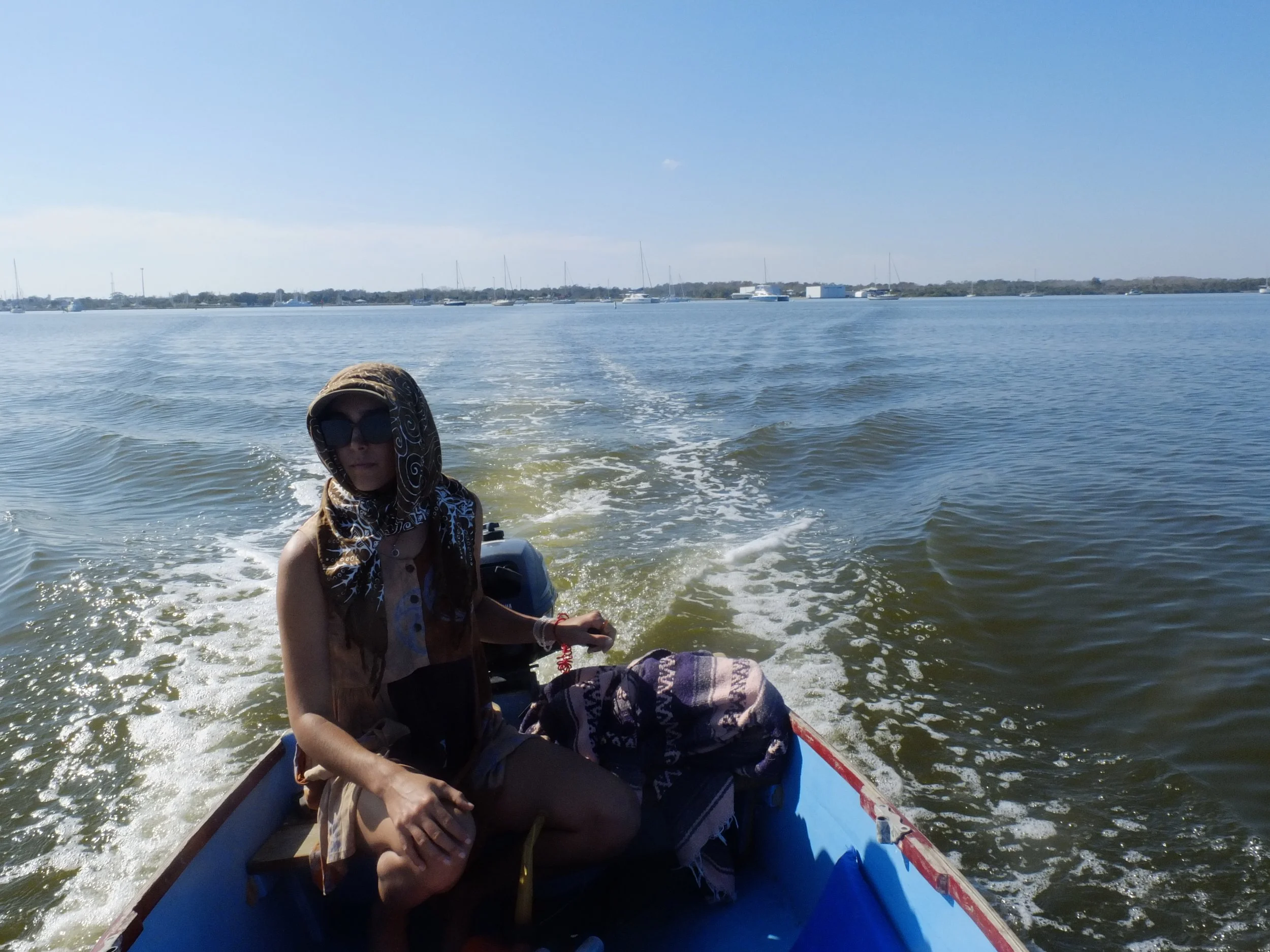
While I was laying on the beach on the lizard island so many things were running through my mind. When I’m passionate about something, I put my heart into it. Was I blind realities of my abilities both mentally and physically? Would me and Ethan’s incomes be able to support the seemingly never ending supply list for Follower? Would ever be comfortable driving Follower after a scary incident of losing engine power? Would my body be able to handle the constant movement while Follower was rocking with the water? I’ve had to come to peace with all the scary unknowns and accept that my love of the ocean and sailing is too deep to go back to land for now.
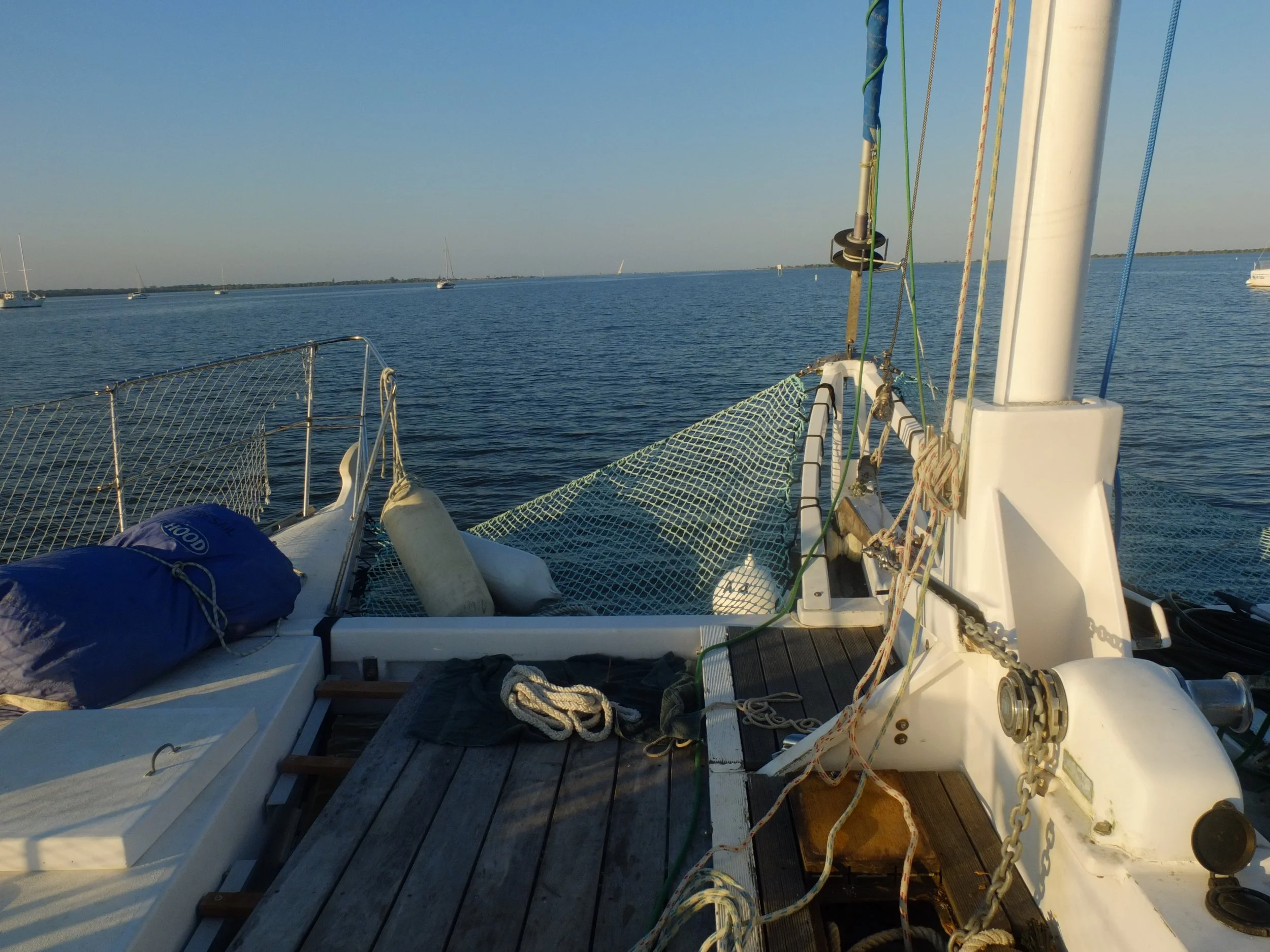
In January, we had to leave Follower on the mooring field in Titusville to go back to work. We lived in a small camper in Ethan’s Grandpa’s driveway and spent every spare moment learning about outboard engines and ordering parts. On the weekends we drove down to Follower and ferried engine parts out with Alice. It was starting to feel like a losing battle. Ethan would have to crawl down into the engine cradles while I handed down parts and tools, careful not to drop them in the water. When running the engines, they would still bog down under high load (such as trying to move Follower against a current). It was hard to stay positive during this time and we were trying to get as much advice as possible to make sure we weren’t spending money on new parts that were not necessary.
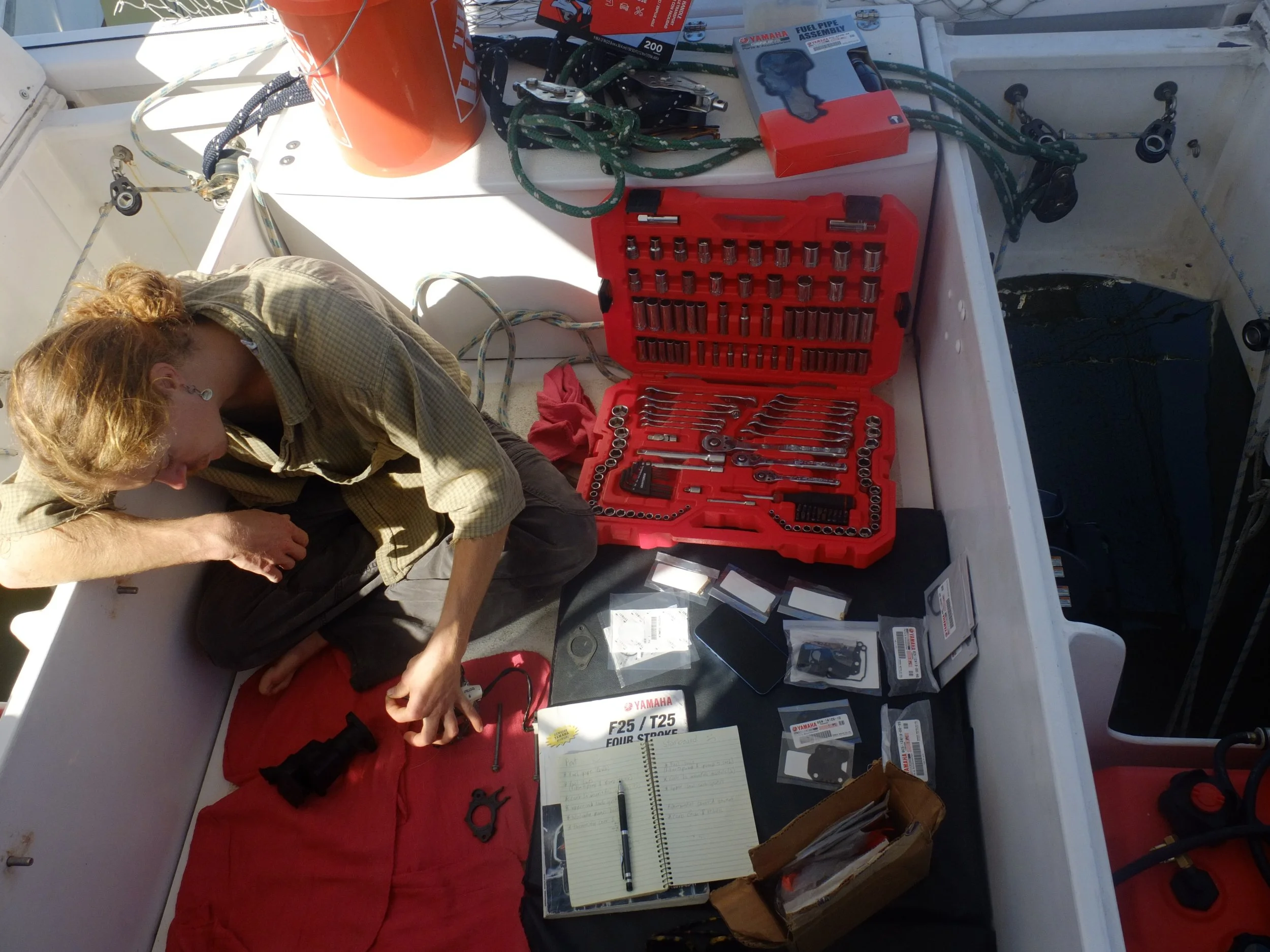
Finally, at the end of January, the engines ran through the paces without any issues. The port engine started running reliably after a new fuel pump and the starboard one after a new carburetor jet. It was very hard to convince myself the engines were not going to leave us stranded again. After a good couple test drives about a mile down the river and back, we were pretty confident they were running good enough to get us home. I felt amazing to be on helm and the excitement of learning to drive her started to outweigh my fears.
On January 28th, my Dad drove me, Ethan and Caden down to Titusville and we packed Follower up with a couple days of food, water and gas. We would be passing many towns in the intercoastal river on the way back but we wanted having to go to land. The next morning we woke up at 06:00, untied from the mooring ball and started heading North. It felt so surreal to finally be moving Follower up the river. I had been thinking about this day for months, tracing the channel on Google Maps and the chart plotter so it would feel familiar.
It was cold with a North wind on our bows and we were running the engines pretty softly at about 5knots as we approached the Haulover Canal.. This is a small canal that connects the Indian River to Mosquito Lagoon with a NASA operated drawn bridge for a supply road of the Kennedy Space Center Launch Complexes. As we turned into the canal, the brown brackish lagoon water looked like coffee against the white sand along the shore and hundreds of birds huddled on beach out of the wind. Ethan hailed the bridge on the radio to request an opening as I steered. The bridge operator accepted our request and I started approaching. When about a few hundred feet away, the operator still had not started the opening and we were all getting concerned. I could certainly slow down but it would be hard to completely stop with how narrow the canal is. Finally Ethan hailed the bridge operator again to ask if there was an issue. And he said very boomingly, “I will open when you are closer”. I’d never seen an operator open a bridge so last minute, our masts cleared as the bridge was still swinging up. It made us nervous and had a little laugh afterwards. I guess he knew what he was doing.
I was hoping that once we got into the wider lagoon we could raise sails, to give the engines a break but with the strong North wind forecasted the whole day, it was never a possibility. Mosquito Lagoon was beautiful, with no signs of people for a couple hours, just an occasional pod of dolphins going by. Me, Ethan and Caden seemed to quickly fall into a routine of one of us on helm, one napping, and one preparing food or hot drinks then switching every hour or so. This changed quickly though as we got closer to Daytona. The channel got narrow with houses lining both sides and a few times we had to coordinate on the radio, maneuvering around other large boats. A group of sailboats, asked why we were going North this time of year? They were heading down to the Bahamas for the winter. We said if it wasn’t for work, we’d be following them.
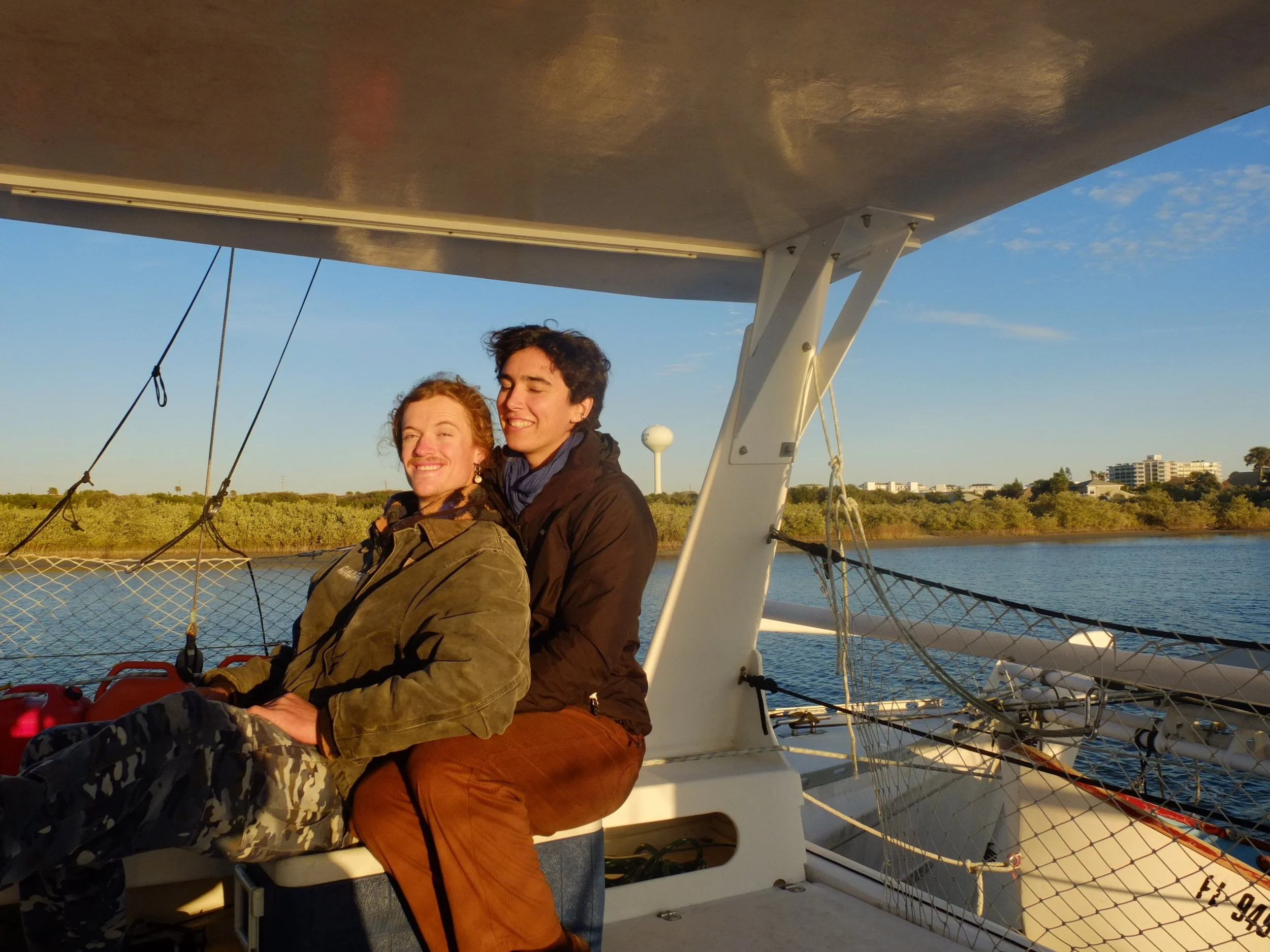
We made it through New Smyrna smoothly and arrived in Daytona around 16:00. The plan was to find an anchorage close to the channel and finish the trip to St. Augustine the next day. Caden was on helm and me and Ethan were looking at charts for an anchorage. We were having a hard time deciding which anchorage to go to and eventually we realized we didn’t want to stop. The vibes were high and we felt so close to home! The engines were running great (making ~8 knots) and a winter storm was supposed to hit North Florida the next day so the sooner we could get to the dock, the better. The only concern was that the days were short and the sun was already starting to set; so we would have to be confident moving through the channel at night.
The sun set quickly and left a pink glow in the Western sky. The wind chill was 10C and it was eerily quiet except for the engines humming. That night we didn’t pass a single other boat. Everything was going smooth until about 21:00 when we passed through the part of the channel that navigates around the Matanzas Inlet. This is a natural inlet and the sand is often pushed from swells, making the channel markers regularly out of date. Me and Caden stood on each bow, with spotlights pointing at the channel markers and watching for sandbars as Ethan steered slowly watching the depth sounder. If I pointed my spotlight into the water, I could see some critters floating by in the strong current. I caught a glimpse of a school of big blue crabs swimming which looked unreal.
Then we stopped moving. We had hit a sand bar. At the moment I was so worried but we quickly were able to back off of it because of how slow we were moving. Now, I have a huge appreciation for Follower shallow draft (3.7 feet under the waterline) making it fairly easy to navigate shallow water. Now we were on the home stretch passing very familiar landmarks in Crescent Beach. Ethan’s Grandpa’s house is right next to the last drawbridge we had to go through and at 23:00 his family waved as we went through the 206 bridge.
Our dock is located in the San Sebastian river, which cuts off the main channel right south of downtown St. Augustine. It was almost midnight and we had made it to the mouth of the river. We debated if we should just anchor there for the night and dock the next day or try to navigate its narrow curves and dock this late. The thought of waking up at the dock sounded so great to me that I took the helm to drive us in.
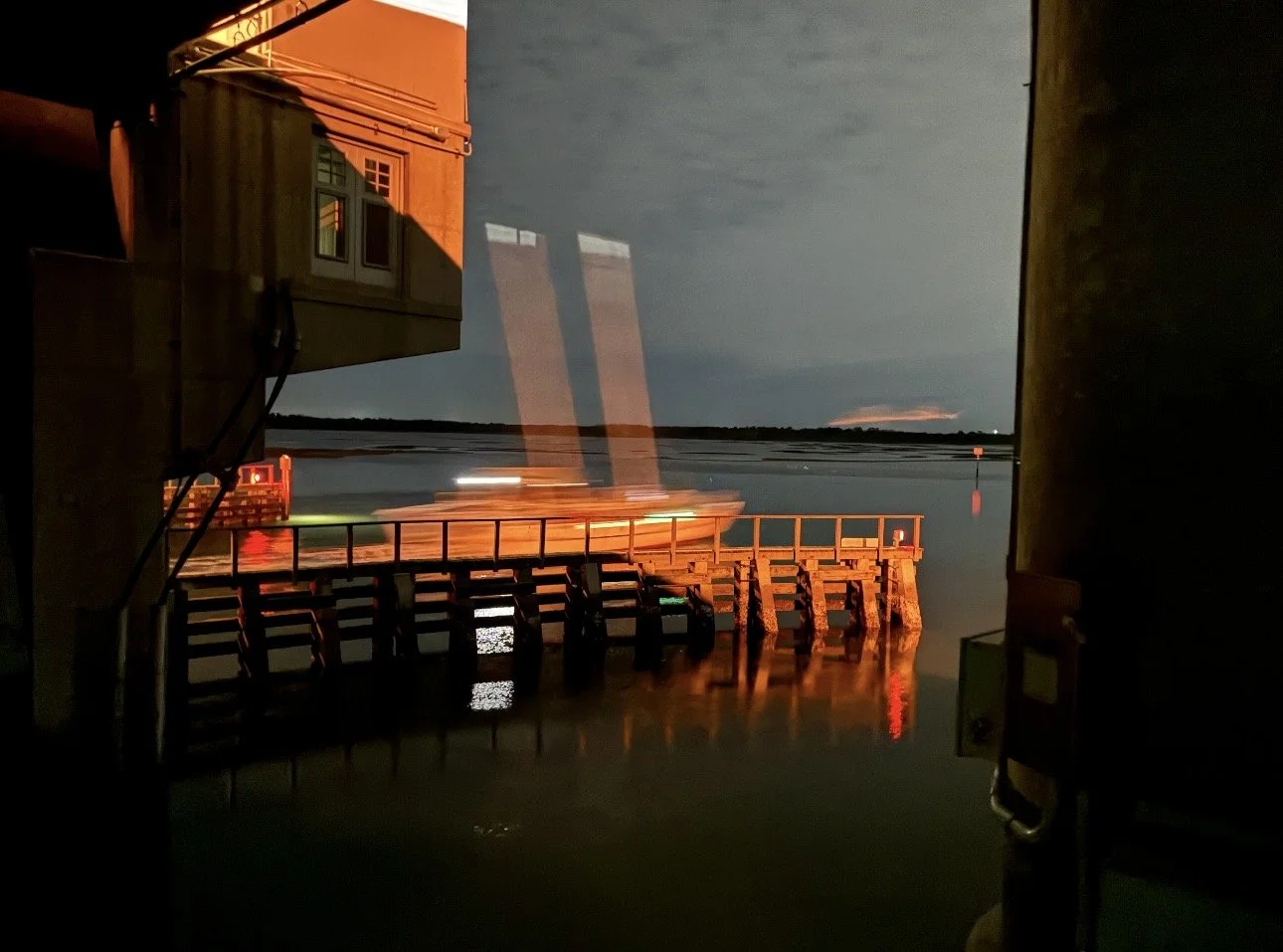
We went really slow. As Caden shined the spotlights at each channel marker I’d carefully line it up with the chart plotter and turn around the bends of the river. It was dark and my eyes were very heavy. The wind had died, which made it easier to steer but it was so glassy that the lights of the docks along the river were reflected so perfectly in the water that it made me feel like I was hallucinating. Finally after a scary half hour of making it up the river (and only hitting one mud flat), I saw our dock and Ethan’s parents waiting to catch lines. It was time to lock in.
Ethan had prepared the fenders and dock lines and we had talked through this maneuver a million times. I have docked many boats but all boats under half the size of the Follower. My stomach was twisted in a knot; one wrong move into the marina and I could severely damage Follower or someone else’s boat. Ethan and Caden just kept reminding me that I could do it. We moved slowly past the dock and I started the turn with the wheel, then put the port engine in forward and the starboard one in reverse. This twisted us parallel to the dock without drifting too far forward into the seawall. The outgoing current caught our stern quicker than I had anticipated having us swing further than I wanted but Fred, Ethan’s dad, caught our stern for a decently smooth docking.
As soon as the dock lines were tied and the engines were cut off, I realized I was shaking. I could not stop smiling but I could not wait to get to sleep so I could take it all in. The boat was calm and safe. I grew up at a house on the San Sebastian river about a mile away from our dock. The salt marsh was my playground as a kid and waking up the first morning in the water felt like returning home. Now I get to experience that playful feeling of the tides pulling me around and spotting wildlife every day. Ever since I left the house on the marsh, I felt this deep pull, an insatiable need to be closer to the water. Now, living full time on Follower, I finally feel like I’ve arrived at where that pull was guiding me.
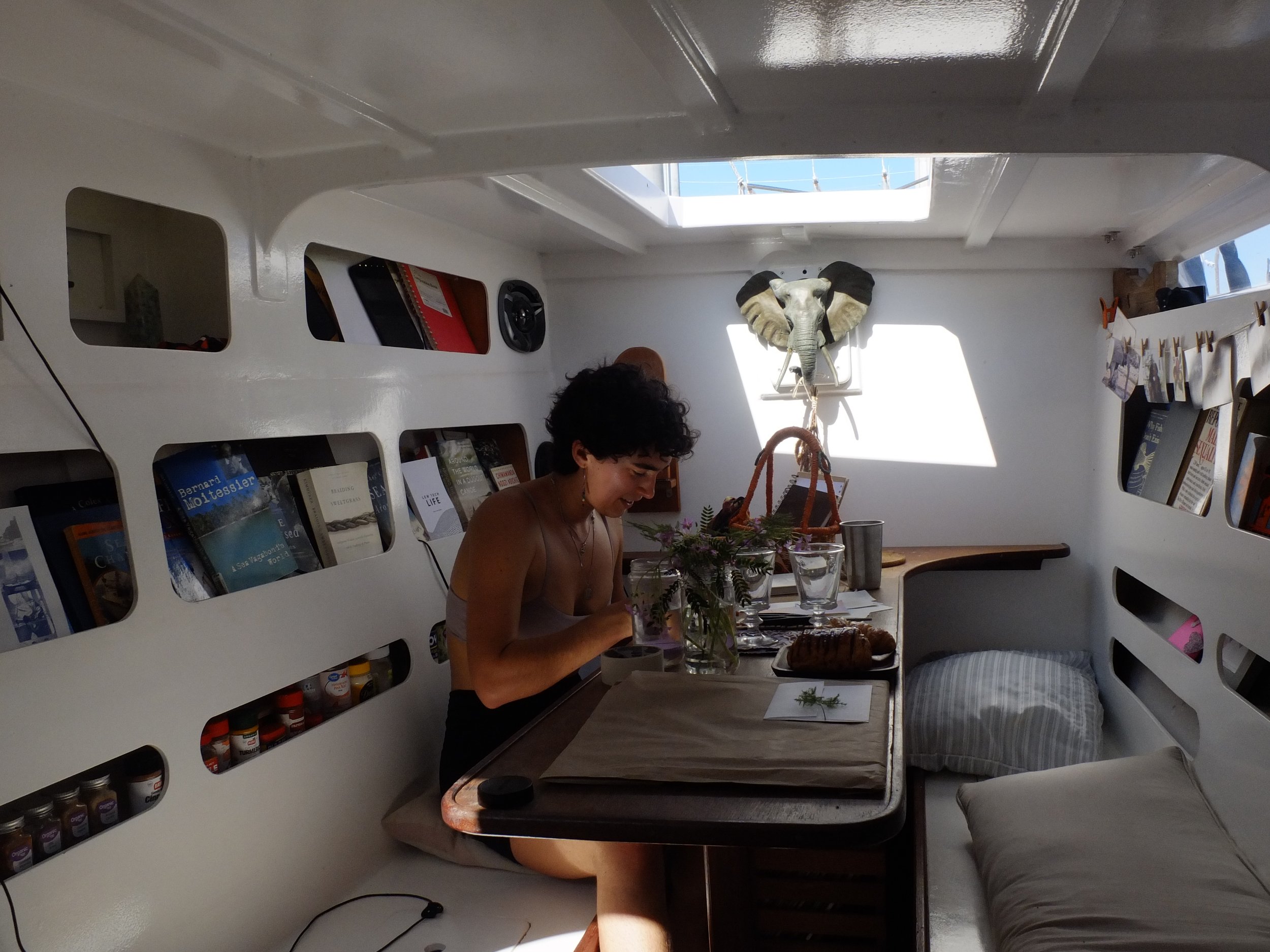
We’ve been living aboard for about 6 months now. I’ve learned so many new ways of living as I call a wooden catamaran my full time home. We are making upgrades and modifications to our living spaces to make things more comfortable but at the end of the day, we live in the water. I’m learning to surrender to the ocean and the weather. It’s made me grow in ways I didn’t even know were possible.
Ethan, when you read this, I hope you help me edit so the writing captures moments I have forgotten about. Everyday, you fill my heart with joy and excitement and continue to impress me with your knowledge and patience. I truly believe we can do anything we set our minds to together.
Follower is currently docked in St. Augustine, Florida while Kai and Ethan are preparing to start ocean sailing next year.