Bali: A Warning to the World of Power and Pressure
The whole world knows its name, yet only few of my western brothers and sisters know more. That’s okay, it’s far and besides, we American folk don’t have much of a reputation for being geographical geniuses. First thing I’ll set straight, Bali is not its own country but rather only one small island in a country of seventeen thousand(+) other islands. What is it about this particular island? A place that endures millions of souls each year. Souls from all corners of the world, except its own it appears. And the number only steadily increasing each year since the 70s, give or take, considering historical moments like volcanic eruptions or global pandemics.
Studying hospitality and tourism for four years introduced me to the basic principles of destination life cycles. Essentially the concept is that hot-spot, trendy, destinations can’t maintain relevance for extended periods, as there is a dramatic demand for growing infrastructure and increased risk of cultural assimilation, otherwise known as loosing the native culture to the masses, the new culture overtaking the old. Any individual destination simply cannot withstand this steady increase of pressure from the outside world, something has got to give. A destination life-cycle must rise and fall like a pendulum. Ripen then expire, awaiting a new fruit to take its place. A new trend. But Bali? It’s like that one fake piece of fruit among a damn sea of real fruit, it never expires, it is always on display.
I thought I had the answers to this mysterious “why here?” figured out before ever stepping foot on Balinese soil, and in fact, I dismissed Bali as a place I’d want to go entirely, based off all the assumptions I collected while traveling. The shit talkers, the “I was there 10 years ago and it was so different” types. And the worst being those who don’t have a clue but hop on the bandwagon (myself). People are quick to say just skip it if you want to experience real Indonesia.
So yeah, I listened. I got aboard the hate train, first stop? My obsessive impulse to do exactly as others are not. Really just a simple case of the classic traveler ego, I would be above all else, I would be better than those who like to do what’s trending. Truth is, everyone that travels long term wants to go off on their own path, forging through uncharted territory to be the first, and post it on Instagram. End up in some slightly bizarre, potentially life-threatening scenario. Make it out alive to tell the tale. Use the least money and go the farthest way. We want off-grid. We want god damn LOCAL because we are travelers! Not tourists!!! It’s like a competition now. Luxury is out, rugged is in.
So first, allow me to squash this negative-talk with a story. The journey begins with my early morning arrival at I Gusti Ngurah Rai International Airport, Denpasar, Bali. To prove as is stated above, allow me to explain. I initially wanted to skip Bali entirely, and head straight for Lombok, its sister island, smaller, lesser traveled, and only a ferry ride away. The common agreement amongst traveling folk being “Lombok is like Bali used to be 20 years ago!” That’s what they say, ya know, how it’s on its way but hasn’t been ruined yet. So I suppose I’d sure as hell rather skip the nonsense and head right for the good stuff. Although, the night before, I happened to pull a luxurious all-nighter on the pristine floors of Singapore International, the cleanest airport around. I was not about to add another 6+ hours to my travel day. It was the weekend, I’ll stay in Bali and see what its really about, I thought.
The story really starts here. I’ve never immediately adjusted to, and been connected within, a new place in any previous destination across my five months of travel... I arrive, collect my bags, grab a bite from the Australian themed airport cafe, and walk out to the arrivals pick up area. I sat on a ledge waiting for my ride to get there. I noticed the girl sitting next to me looked cool. I needed data at this point but couldn’t be bothered to walk back inside for Wifi. I’ll just ask her if i can borrow a hotspot. We get to chatting, exchange Instagram’s. She’s local, and so nice I thought, i thanked her then I was on my way.
The rest is history. I have seen this girl almost everyday for a month now. We clicked, I met her friends and their friends and so on. Before Bali, I was in a place of staleness and had an intense craving for more structure in my routine besides solely floating from country to country. These new relationships thrust me into taking charge. I facilitated this new found momentum in life amongst myself and, in turn, my new friend as well. We have been working on projects and ideas we’ve created together, enjoying life, building brands and talking about our futures. I entered a world of amazingly kind people and new limitless possibility through this chance encounter, and all jokes aside, my life is truly on a different trajectory now than it was before. I’m so grateful.
What you have to understand, and the thing I was missing before, is that the real Bali still exists. It isn’t only a fruitful land of beach clubs and fitness hubs, as seen on Instagram reels. The authentic side now co-exists with the parts that have been manufactured to fit the growing influx of people. The influencers playground, if you will.
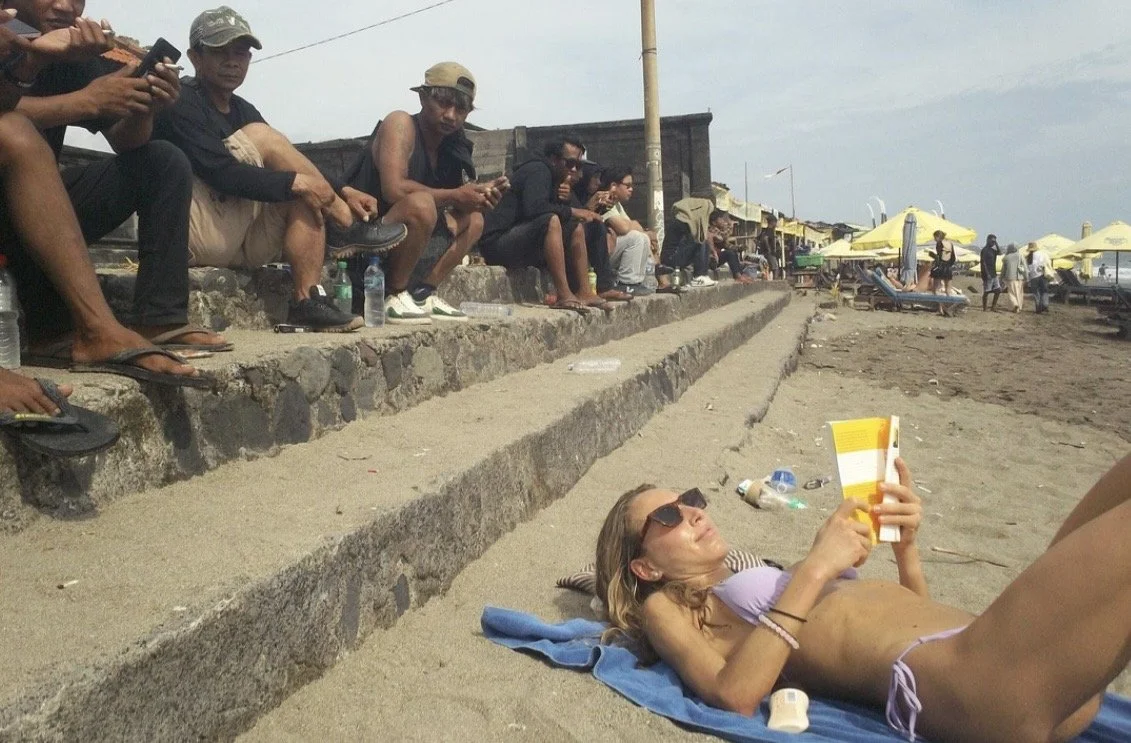
Let me be the one to tell you that the heritage and Balinese culture is still very much present. I’ll tell you about some of the most notable things!
The other day i drove by a temple that I’d noticed, inside the courtyard, a group of young boys and men drilling hammering and piecing together a 20 foot tall, terrifyingly detailed demon-like display. This naturally raised questions. So I asked and found. These grim, creepy little creations are the finale, the spectacle of all spectacles, the main event of the yearly, beloved, purification festival, known as Ogoh-Ogoh. It is a massive parade, lighting up the streets of Bali and Bali only. I urge you to look up a video of these strangely magnetic happenings on YouTube, its really quite a scene. This is a traditional Hindu celebration. The demon figurines are spun around, there is loud music, flames, chaos. It’s a big party. And during the finale they are set aflame, burnt to cleanse the island and its inhabitants, ridding it of negativity. What follows, is a day of complete silence.
Nyepi, or the Balinese Day of Silence is the Hindu New Year. The island shuts down. The airports close. The streets empty. The homes, only lit from within, dark from outside. No one in Bali, no one out. My body lit up with goosebumps as I wrote this because the land needs it, in a cry for help, for calmness, it really gets it, gets to breath on this one day. Complete stillness woven into the modern world, by the use of an ancient religious practice, on the island of the most touristic influence in the world. How powerful is that?
The other night I rode home from my friends at 4am. The roads were quite empty but certainly not the innocent presence beside them. Families, sat and talking, little kids playing with toy cars. Chopping, boiling, frying ingredients, and the smell of sizzling spices and early morning dew in the air. Each room seemingly in its own world in my brief passing. It didn’t make sense then, but I later learned early morning food shopping is an essential part of the Balinese culture. From 5 am till 8 am, the traditional hours of rest are replaced with bustling activity, all set and done before the heat of the day sets in.
You’ll be reminded of Bali’s strong Hindu roots everywhere you go. There is a tradition called Canang Sari where each day, these small palm leaf trays containing food, money, flowers, cigarettes, or anything regarded highly, are placed outside on either the ground or a higher surface. Where the higher offerings represent the higher benevolent forces and the ground level offerings appease the lower malevolent forces. A daily sacrifice meant to maintain cosmic balance and harmony, representing gratitude and devotion. To thank the gods for life and peace.
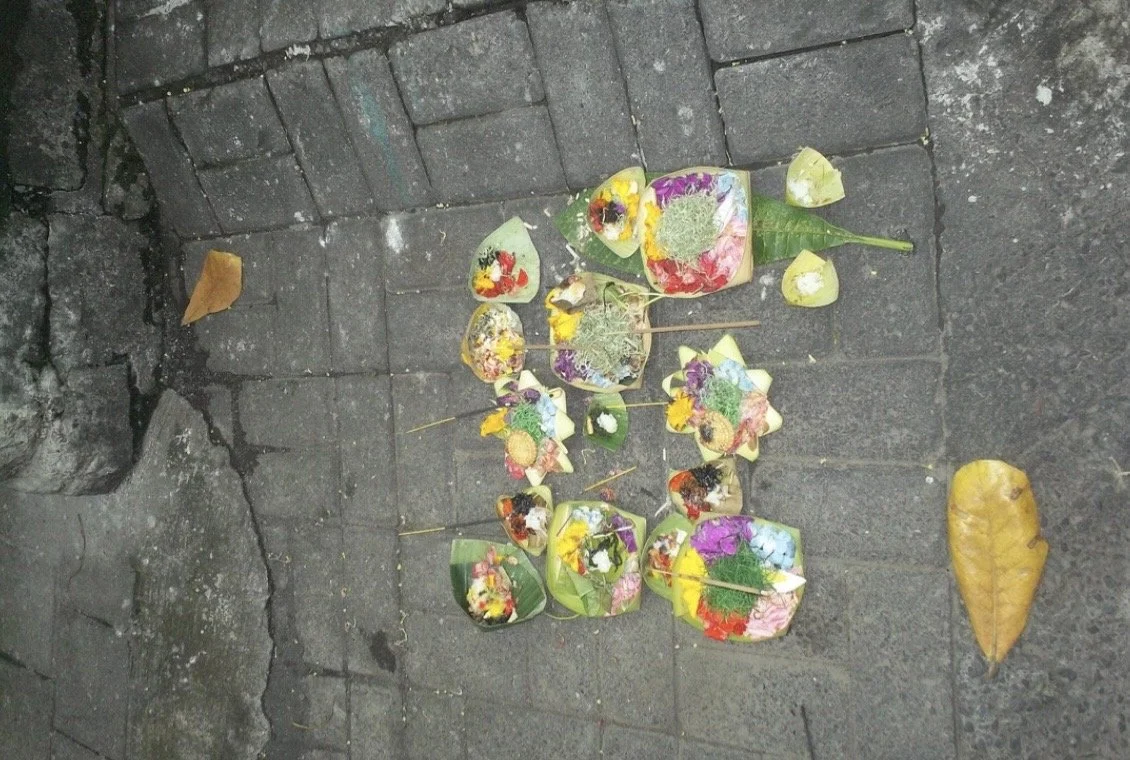
You know they call this place, Bali, the island of the gods. But, also, the island of the demons. It’s all about balance here, both high and low shall be acknowledged, and both equally respected.
To piggyback on its intense spiritual forthcomings, its commonly regarded that Bali picks its people, suggesting that your energy, be it fitting, will thrive and with it welcomes you to a place of personal growth and connection, a feeling of true belonging here. If your energy does not match, its said things will not work out for you, leading to a departure. I think this is all connected.
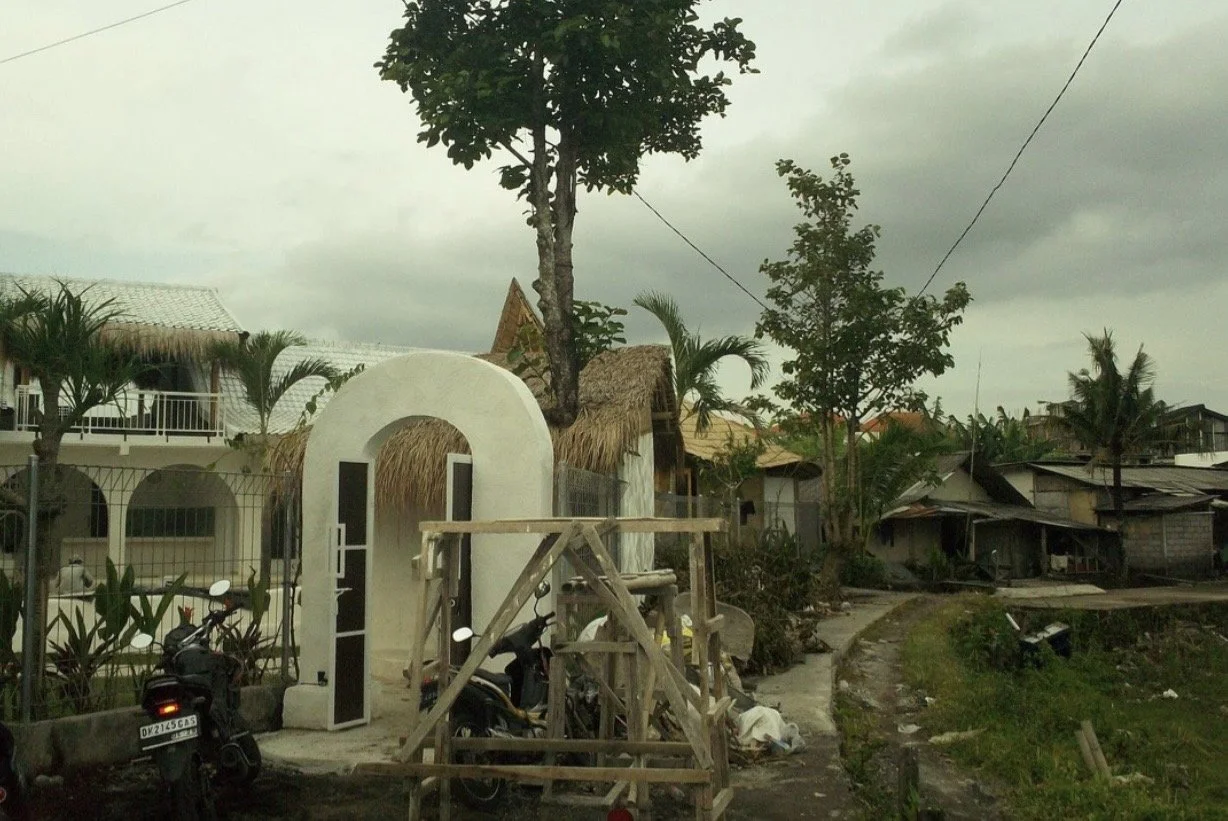
In a once rural fishing village, lies a bustling town called Canggu. Amidst the thick black, smog-ridden streets and tucked into any spare vacant plot, or unused clearing, here you’ll notice rows of elegant, arched entry way, white-marbled, luxury cafes work spaces and pilates studios alike. You’ll see hanging wooden signs outside of these structures, reading some ridiculous name like Villa Almond. Behind it, more layers of poorly advertised, seemingly empty wellness compounds. Even certain streets lined with giant low-budget billboard ads featuring next-to-naked women in lingerie or cheesy mis-spelt English slogans. This town is one of most notable impact by tourism on the entire island.
And behind it all, hidden in plain sight, there lays untouched lush rice terraces, cows grazing pastures, Balinese farmers in pointy straw hats. You can hear the birds, the wind and not much else. It’s amazing, calming and relaxing to be in these parts. Crumbling ancient temples stand, built into winding streets running through small communities, local neighborhoods, and all the while, an army of obnoxious scooters speeding by, through these sacred roads. It’s nuts to see honestly.
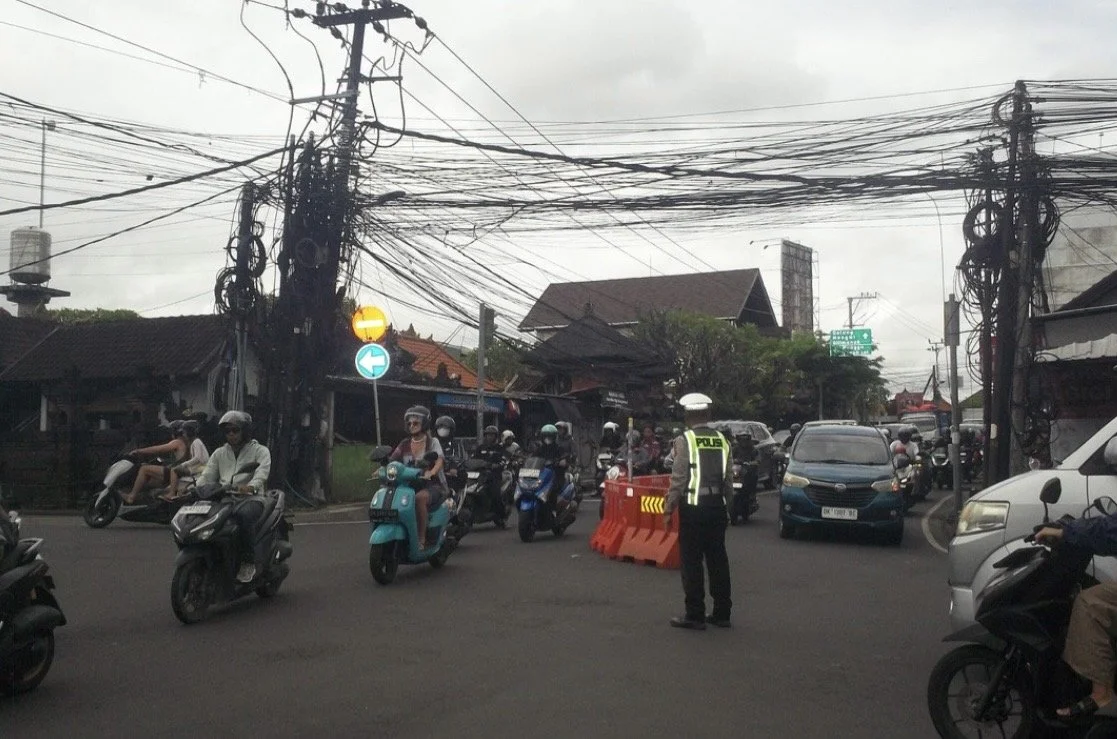
With that, I’m trying to express that being here feels like two worlds co-existing beside one another. The locals and tourists, both living their more or less separate lives and benefitting off each other (in order to achieve peace and harmony all throughout the land?) But who is really benefitting? Sometimes, it sure doesn’t feel like its the locals. At a certain point, their livelihoods are strained every single day. Tourists can leave, locals are met with no place to go or money to afford going, they stay.
They adapt, and move forward, making it all fit within their more-or-less simplistic, community-driven lives. Take a moment to imagine that scene from the Lorax. The scene that captures his absolute powerlessness, his inability to stop the big companies with their big machinery from destroying the land, the utter grief he feels for the state of the planet, as it is being irreversibly manufactured. Torn apart in front of his eyes.
Really, the tourists aren’t to blame here. No. It’s those guys that you don’t see. The ones that exist out there somewhere in space, with too much money. The developers, the investors. Naturally they’re greedy, profit-hungry shit bags who don’t care about the wellbeing of the planet, it just comes with the role. So they see the high-profit tourism landscape and want a piece for themselves, regardless of how excessive and chaotic it all is. The place feels lawless. And sometimes the land just happens to turn into major headliner, world-renown beach clubs and obnoxious luxury resort compounds. Of course, with this infrastructure it makes Bali the perfect place to be for holiday-seekers. It now has it all. And the vicious cycle has begun. I mean this is happening everywhere people. Just go and you’ll see. Rich guys taking land and doing whatever they want with it. I saw it in Morocco, I saw it in Sri Lanka. It’s so disheartening to see with your own eyes. It’s happening around the whole wide world.
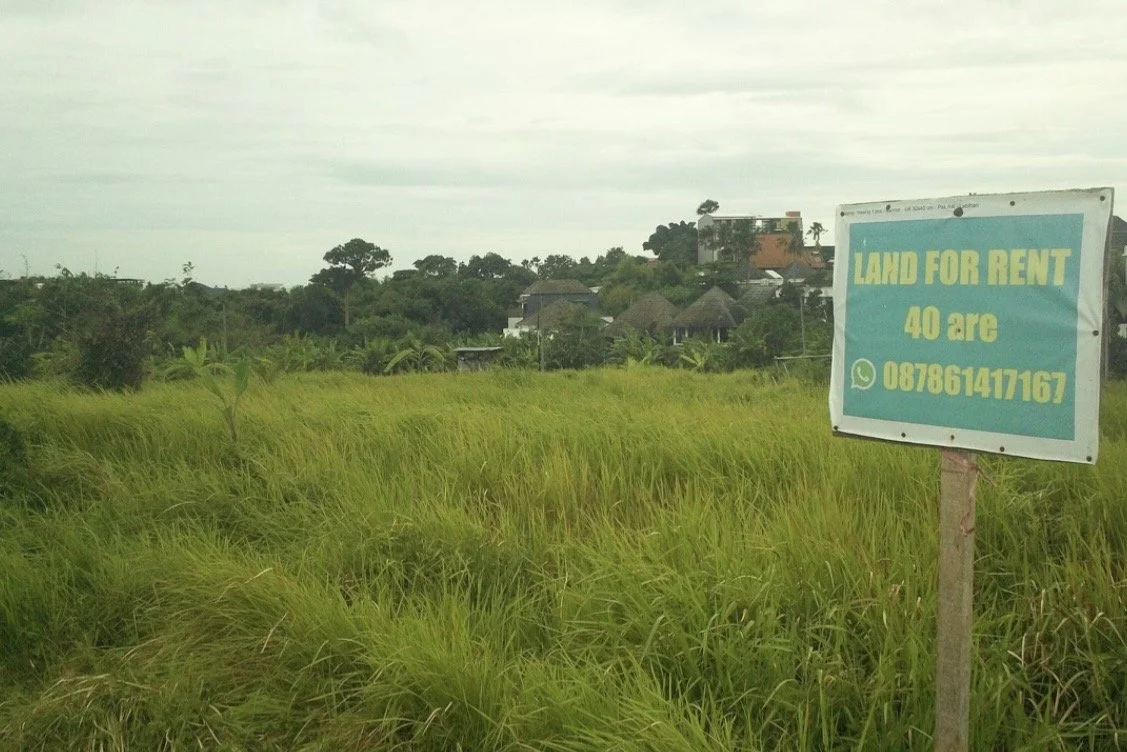
Something occurred to me whilst sitting on the back of scooters being driven around town. Apart from being driven onto crooked sidewalks, or through tiny gaps in between on-coming traffic, and the common method of tailing who’s in front of you till the perfect moment to cut someone off and gun it, I noticed that most of this chaos isn’t just tourist folk. But instead this is a prime, indirect effect, on the place BY the over-tourism. Most of the traffic is Indonesian people, and i just got this woah moment. Many, even most, of the Indonesian people aren’t originally from Bali, they grow up on other islands, and move here. They chose this. For opportunity, for it is where the tourism is therefore the money too. Its just like any other country where the people want to be where the things are happening. And unlike New York or LA, Bali doesn’t particularly have the same space for the rapid influx of infrastructure or people.
The Balinese are highly exposed to the western people, therefore the Western greed has crept in as well. It used to be about sharing and helping and caring for one another. Now it is about money money money.
Yet another major concern arises when an economy is entirely reliant on tourism. Nothing good happens when it all, one day, drops off a cliff. March 2020, the world shuts down, we’re all familiar. The land gets to breathe, but panic sets in for the people who lived off the money of their high-paying foreign friends. Bali experienced a detrimental loss in tourism and those in the industry retreated back home to more traditional ways of work. 2022, restrictions are lifted. The initiative was to accelerate recovery from lost tourism. Vacationers and travelers were ready to leave, pent-up people meant demand was high. Indonesia responded. Aggressive marketing campaigns. Easier visas. Simpler requirements. Remote work accelerated. Restored flights. And it was game on from there.
This sacred land stands on a path that threatens its future. Where life itself may no longer be sustainable. But this is not only Bali’s story. It is a reflection of the human condition, shaped by the relentless pursuit of money, power, and greed. Bali is merely one warning among many. Across the globe, places of beauty and culture are struggling under the same forces. The world itself is beginning to burn, and Bali is one of the first flames. When the fire finally dies, what remains won’t be growth, but darkness.